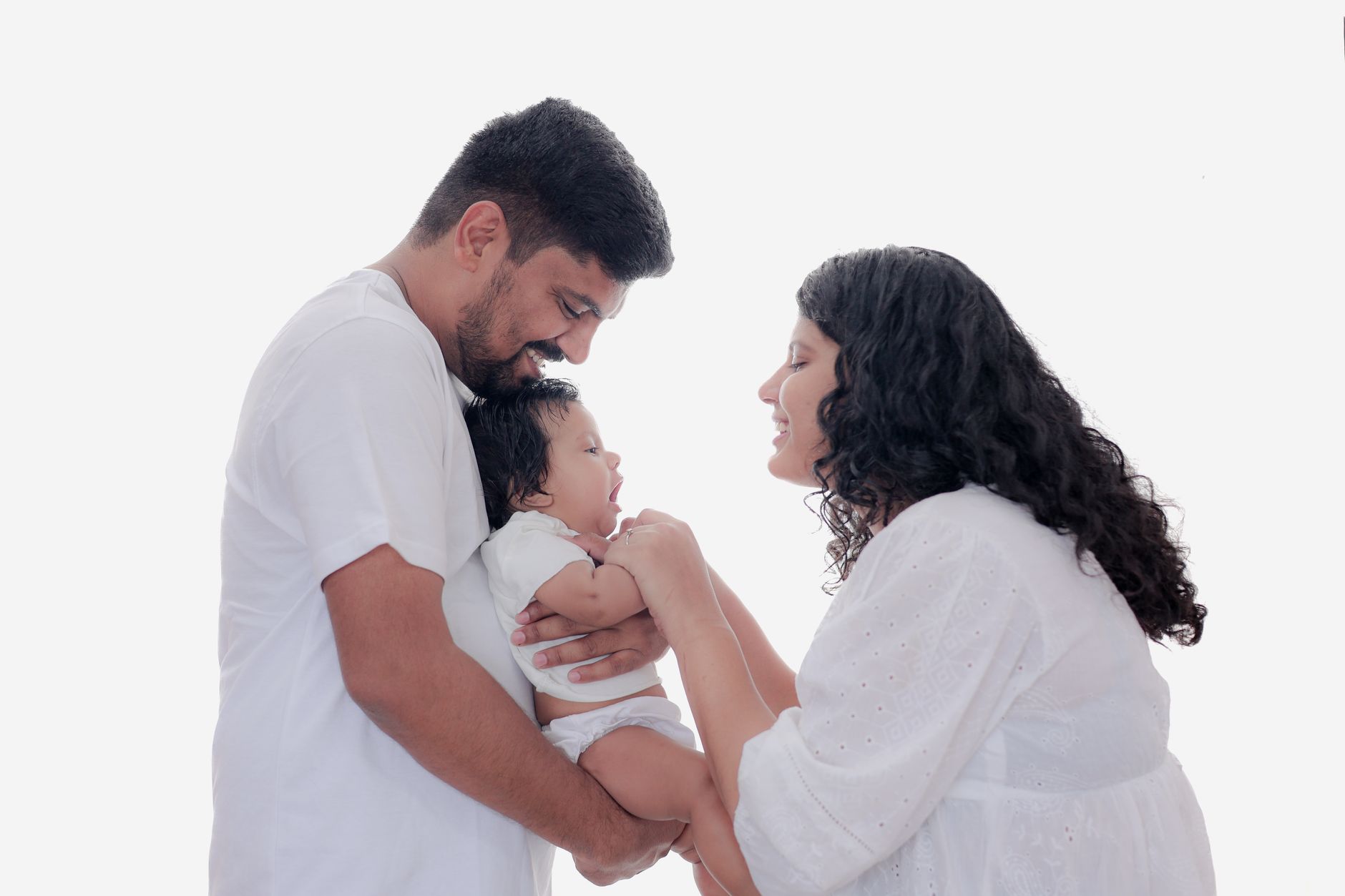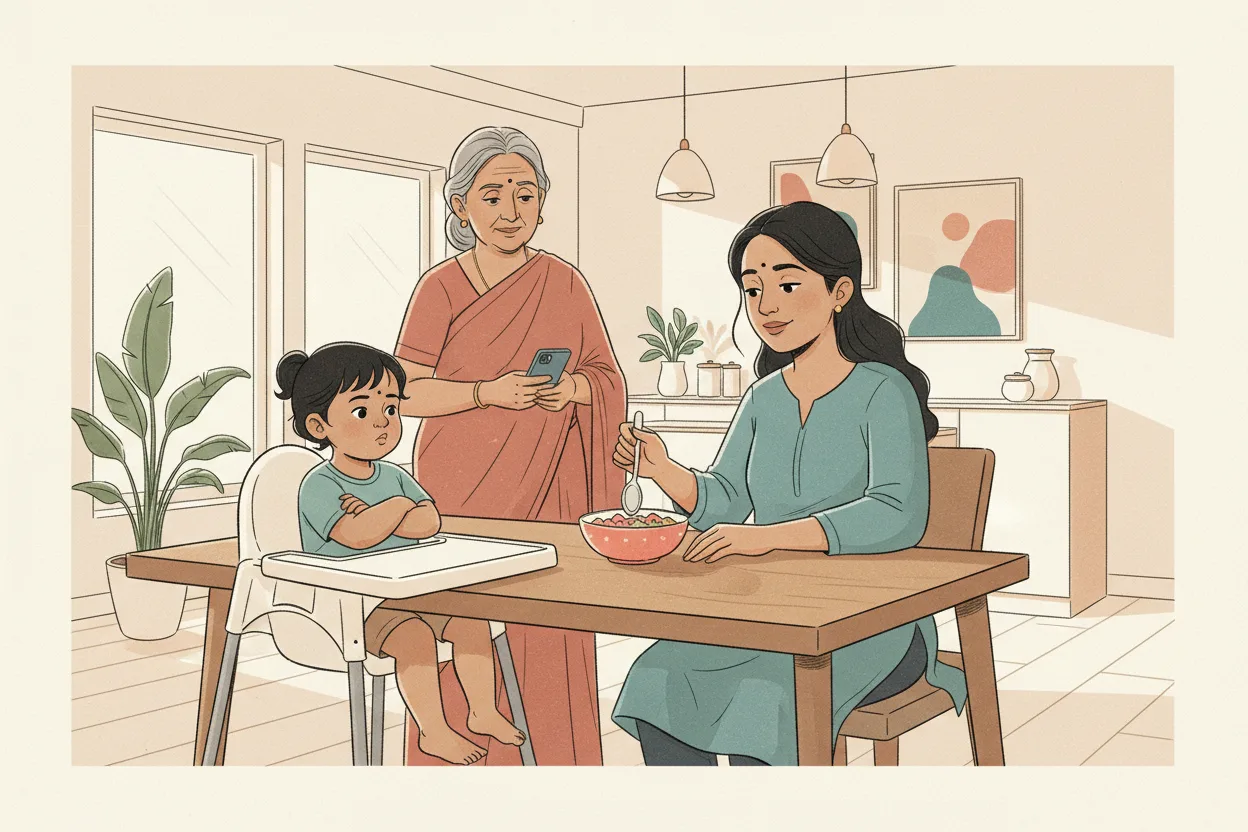


Ask for the time around a feed, a nap, or the first hour after a bath — a specific, recurring window tied to something baby needs — rather than a general request for privacy. A concrete ask that repeats daily is much easier for a household to absorb than an open-ended one, and it can be phrased without sounding like a complaint about anyone.
Not medical advice — consult your pediatrician for concerns specific to your baby.
Why This Feels Harder Under One Roof
With your own mother, you can usually just say what you mean. With in-laws — especially early on, while you're still finding your footing in the house — the same request can feel like it needs to be managed, softened, timed right, run past your partner first. That instinct isn't wrong. It just means the ask has to do more work: it has to be about your baby's routine, not about anyone's feelings, so there's nothing in it to take personally.
This living arrangement is far more common than it can feel in the moment. A 2015 study of over 17,000 married women across six cities in Uttar Pradesh found that nearly two-thirds lived in their husband's extended family home, and about a third lived directly with their mother-in-law — so the daily choreography of asking for space under a shared roof is something most Indian new mothers are navigating too, not a sign that something about your household is unusual.
What the Quiet Time Is Actually For
Skin-to-skin holding in the early weeks does real, measurable things for your baby. HealthyChildren.org (AAP) explains that close physical contact with a parent can promote bonding and the release of feel-good hormones, and can also help regulate your baby's body temperature and heart rate. That's a good reason to protect a window for it, not just a preference.
The first few months are also a uniquely sensitive stretch for the parent-baby relationship itself. A longitudinal study in PMC/NCBI found that the first months after birth are a highly sensitive period for the bonding between parents and their infant — which is worth naming out loud to family, since it reframes "we want this time" as something time-limited and biologically real, not a rejection of their help.
It isn't only about the mother. HealthyChildren.org (AAP) reports that, compared with newborns left in a bassinet in the first two hours after birth, a baby placed on their father's bare chest cries less, falls asleep sooner, and shows less agitation. If dad hasn't had his own uninterrupted stretch with the baby yet, that's a legitimate ask too — not something to request only on the mother's behalf.
There's a quieter mechanism working in the background as well: a peer-reviewed review in PMC/NCBI found that newborns learn to recognize their own mother's distinctive scent within days of birth, a process thought to support early mother-infant attachment. Long, close holds in the first weeks are part of how that recognition builds.
What the Research Actually Says About Family Help
It's tempting to treat "less family involvement" as automatically better, but that's not quite what the evidence shows. A 2022 study in Women's Health (London) of joint families in rural Pakistan — a household structure close to many Indian homes — found that in families with existing conflict, heavy mother-in-law involvement in childcare around 12 months postpartum was associated with a higher prevalence of perinatal depression, even though similar involvement earlier, around 3 months, was protective. In other words: the same help can land differently depending on the underlying relationship and the baby's age — it isn't simply "more hands = worse" or "more hands = better."
That's exactly why naming what you need, rather than silently resenting the interruptions or silently accepting all of them, matters. The American Academy of Pediatrics advises that clear communication, patience, and consistency can help get everyone — parents and grandparents included — on the same team, rather than treating it as a standoff.
Signs Your Baby Needs Fewer Hands, Not More
Two developmental facts are worth knowing, because they give you a neutral, baby-centred reason for a boundary that has nothing to do with anyone's feelings.
Passing baby around too much can genuinely overwhelm her. Healthline notes that some babies enjoy meeting lots of people, while others get quickly overwhelmed by new faces or a crowd. If your baby is fussing after being handed from lap to lap for twenty minutes, that's her signal, not a slight to whoever was holding her last.
Around 8 months, a new wariness of faces is normal — and it isn't rejection. HealthyChildren.org (AAP) explains that starting around this age, even relatives and frequent babysitters your baby was once comfortable with may prompt her to hide or cry now, especially if they approach her hastily. Telling grandparents this in advance — "she's at the stage where she needs a minute to warm up, it's not personal" — heads off hurt feelings before they start.
Scripts That Don't Sound Ungrateful
The pattern that works: name the routine, not the person. "I'm trying to feed her in the quiet for the next 20 minutes, can I come find you after?" lands very differently from "please stop coming in." A few that hold up in daily use:
- "She's due for her nap feed — I'll bring her out once she's settled, maybe 30 minutes."
- "The doctor mentioned skin-to-skin time helps in these first weeks, so we're doing it right after every bath."
- "He hasn't had his turn holding her today — can she come find you after his hour?"
- "She's at the stage where new faces overwhelm her fast — if we ease her in for a minute first, she settles much better with you."
Say it once as a routine, not a rule announced at a family meeting — repetition at the same time each day teaches the household the pattern faster than any single conversation will.
Making the Boundary Easy to Keep
A few practical, low-conflict tools help the routine hold without repeating the ask every day.
| Tool | What it does | Price Range | Where to Buy |
|---|---|---|---|
| Soft structured baby carrier | Keeps baby close to you through the house, so time together doesn't depend on a closed door | Rs. 1,800 – Rs. 4,500 | Amazon.in / FirstCry |
| "Feeding / napping" door hanger | A wordless, non-confrontational signal for a closed door at the same times daily | Rs. 150 – Rs. 400 | Amazon.in |
| White noise / sound machine | Lets baby settle in her own room without needing the whole house to go silent | Rs. 900 – Rs. 2,500 | Amazon.in / FirstCry |
Frequently Asked Questions
How do I ask for bonding time without sounding ungrateful for the help? Tie the ask to a specific, recurring routine — a feed, a nap, the after-bath hour — instead of a general request for space. A routine repeats itself and explains itself; a one-off request can read as a rejection of the help itself.
Is it normal for my baby to cry when relatives hold her? Often, yes, especially starting around 8 months, when a normal wariness of faces she doesn't see daily can appear — even toward relatives she was previously fine with. Giving her a minute to warm up first usually helps.
Does skin-to-skin time still matter once the newborn stage is over? The strongest evidence for it is in the early weeks, and the first months generally are a especially sensitive window for building the parent-baby bond — which is exactly why protecting that early time is worth being deliberate about.
My mother-in-law wants to hold the baby every time she fusses. Is that a problem? Not on its own — but some babies do get overwhelmed by being passed between people, especially if it happens often in a short stretch. Watch how your baby responds rather than treating either extreme as the rule.
Will limiting babysitting hurt my relationship with my in-laws? It doesn't have to. The AAP frames this as building a team through clear, calm, consistent communication — and research on joint families suggests the quality of the relationship, not simply how much help is given, is what matters most over time.
Should my partner get dedicated bonding time too, or is this mainly about the mother? Both. The AAP reports that a father's early hands-on holding measurably calms a newborn — babies held on their father's chest cry less and settle faster than those left in a bassinet. Ask for his turn by name, the same way you ask for yours.
Not medical advice — consult your pediatrician for concerns specific to your baby.