Your instinct is right, and so is the literature, and the two do not actually disagree. A couple of drops once a day is a small exposure. What drives tooth decay is the pattern — because WHO's oral health fact sheet explains that caries results when plaque converts the free sugars in foods and drinks into acids that destroy the tooth over time, and that it takes a continued high intake of free sugars, inadequate exposure to fluoride and a lack of removal of plaque by toothbrushing to lead to caries.
So the ingredient list is the least interesting part of this. When you give it, and what happens in the mouth afterwards, matter far more. And the form you were handed is the gentler one: a 2025 narrative review in Health Science Reports notes that drops are preferred over syrups because the risk of dentition involvement is lower.
Keep giving the drops.
Not medical advice — never stop or switch a prescribed supplement without speaking to your pediatrician.
The Proportion Question, Taken Seriously
You said you suspect the amount is negligible. Here is the honest version of that.
The benchmark is a daily one, not a per-dose one. WHO's healthy diet guidance asks that free sugars be limited to less than 10% of total daily energy intake, ideally under 5%, and that salt and sugars not be added to complementary foods at all. A once-daily dropper does not move a day's total the way a biscuit at teatime does.
But the concentration in Indian paediatric liquids is genuinely high, and that is worth knowing rather than hand-waving. A 2024 analysis of the 15 most sold or prescribed paediatric liquid medicines in India, published in the Journal of Pediatric Pharmacology and Therapeutics, found 14 of the 15 contained sugar at concentrations ranging from 6.1% to 78.7%, with multivitamins among the high-sugar categories, and 12 of the 15 sitting below the critical pH for enamel demineralisation. Note the second half of that: acidity, not only sugar.
Concentration times a dropper volume is still a dropper volume. That is why the proportion argument holds here and weakens for a spoonful of syrup given twice a day for months — the same 2025 review is explicit that drops carry a lower risk to the dentition than syrups.
What the Sweetener Is Actually Doing in There
Not just making it nice. Vitamin preparations are oily, bitter or metallic, and a baby that spits the dose straight back out gets none of it. A 2018 literature review in the International Journal of Health Sciences explains that the role of sweeteners in paediatric medications is generally related to compliance, that manufacturers add them to mask the original taste and smell of their formulations, and that sucrose — a preservative, an antioxidant, a solvent and a thickening agent as well as a sweetener — is the most used sweetener in paediatric preparations. The same review notes glycerin often doubles as a stabiliser and auxiliary solvent.
That is the part worth sitting with: several of these ingredients are structural. A 2021 review of excipients in the paediatric population in Pharmaceutics records that glycerol is used as a solvent, sweetener, viscosity agent and preservative — so "glycerol" on your label is probably not there to sweeten.
"Sugar-Free" Can Still Mean a Sugar Alcohol
And that is mostly good news, with one caveat.
The 2018 review records that sorbitol is considered non-cariogenic, that it is used as the vehicle in sugar-free liquid preparations, and that polyols in general are only weakly fermented by most oral bacteria. For teeth, that is the whole point of the swap.
The caveat is the gut, not the mouth. The Pharmaceutics review notes sorbitol is laxative at high doses and can cause abdominal pain, swelling, flatulence, vomiting and osmotic diarrhoea, and makes the broader point that just because excipients are necessary does not mean they are toxicity-free products. At dropper doses this is a footnote, not a warning — but it is why "sugar-free" is not the same as "inert".
Where Sugar in Medicine Genuinely Matters
The evidence here is real. It simply points somewhere other than your dropper.
Frequency is the mechanism. A 2015 survey of Indian paediatricians in the Journal of International Oral Health makes the point plainly: giving sweetened paediatric liquid medicines between meals increases the total number of daily sugar exposures. One dose with breakfast adds one exposure; four doses of cough syrup across an evening add four.
And duration. The Pharmaceutics review states that when a patient needs prolonged treatment with sucrose-containing preparations, they are at risk of dental damage. The classic case is a child on months of nightly syrup — anti-epileptics, long-run antihistamines, reflux medication — not a year of morning vitamin D.
| Pattern | Where it sits |
|---|---|
| A dropper of vitamin D once a day, with a feed | Low concern — one exposure, small volume |
| A daily multivitamin syrup by the spoon | Worth asking about, especially if it runs for months |
| Nightly syrup, long term, last thing before sleep | The case the literature is actually about |
| Drops added to a bottle the baby takes to bed | Avoid — this is the one to change today |
That last row is not a judgement call. The AAP warns that putting a child to sleep with a bottle allows sugars to linger on the teeth, and NHS parent guidance says never to give sugary drinks in a feeding bottle, as it can cause very rapid tooth decay, and never to dip dummies in anything sweet. Give the dose from the dropper, directly. (The same logic explains why a sweet drink sipped slowly all afternoon is worse than the same drink finished at once — we covered that in insulated straw sippers for toddlers.)
What Actually Moves the Needle
Not the label. These:
- Give it with a feed or a meal, not as the last thing before sleep. The 2025 review advises dosing at mealtimes because oral clearance is slower at night, and NHS parent guidance says the same — if possible, give medicines at mealtimes and not last thing at night.
- Clean afterwards, at the right moment. The Indian 2024 analysis suggests rinsing the teeth with water after the medicine and brushing 30 to 60 minutes later — the 2025 review likewise says to wash the mouth with water but avoid brushing immediately, because enamel softened by an acidic liquid does not want a brush on it straight away.
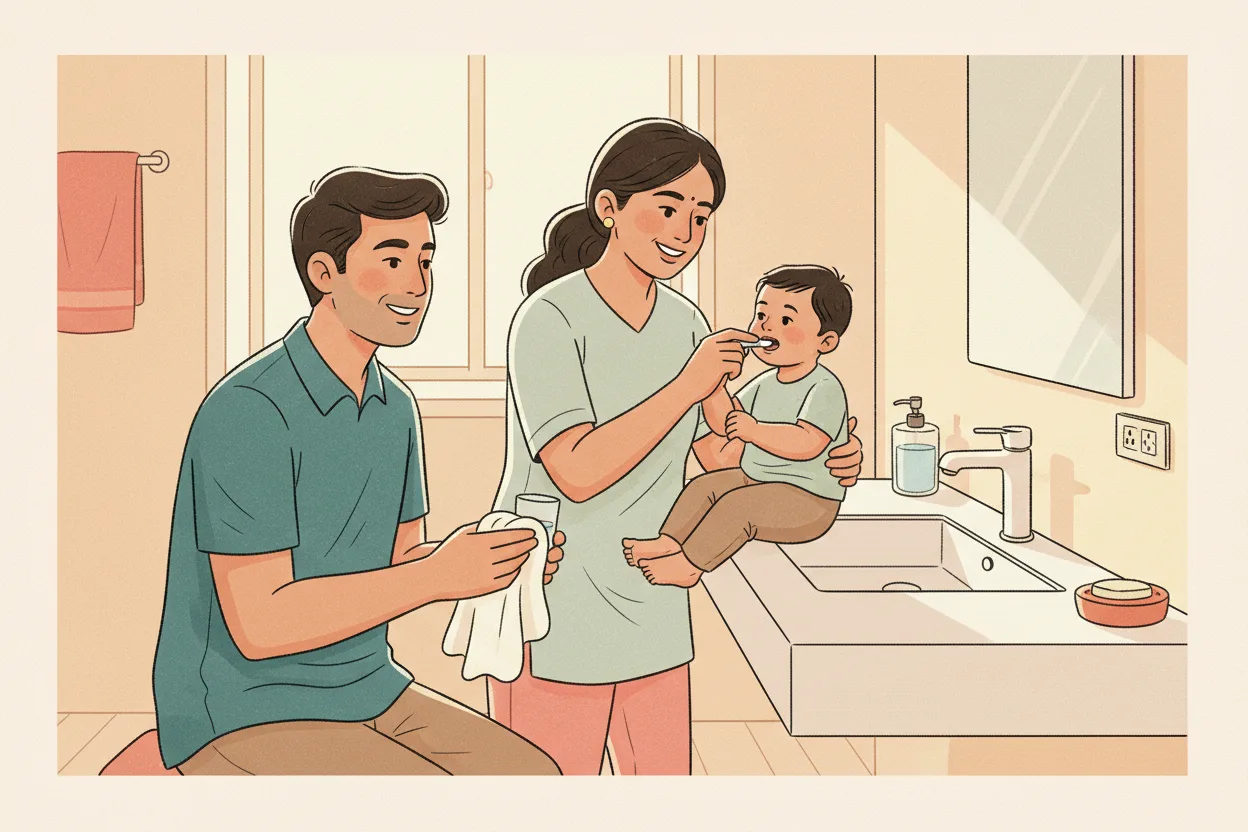
- Before teeth, use a cloth. The AAP advises wiping the gums and any erupting teeth after feeds to minimise the risk of decay.
- Once a tooth is through, brush twice a day — and make one of them bedtime. The NHS advises starting as soon as the first milk tooth breaks through, brushing twice daily for about two minutes with toothpaste containing no less than 1,000ppm fluoride for under-3s, last thing at night and on one other occasion. The AAP puts the amount at a smear about the size of a grain of rice on a soft-bristled brush.
- Book the first dental visit earlier than you think. The NHS says to take your child to the dentist when the first milk teeth appear, or before 12 months of age, and the AAP says the first tooth appearing is the cue to schedule that first visit. Almost nobody in India books it that early.
Your paediatrician may not raise any of this unprompted. The 2015 Indian survey found 74% of paediatricians advised rinsing the mouth with water after a liquid medicine, but only 30% advised brushing with toothpaste, and only 58% advised regular dental check-ups for these children. This is a gap in the standard script, not a secret.
Is There a Sugar-Free Version? The Honest Answer
We could not verify which specific sugar-free paediatric vitamin preparations are stocked in Indian pharmacies right now — formulations and availability change, and a product label is not evidence of anything medical. That is a question for your pharmacist, with the actual bottle in hand. NHS parent guidance acknowledges that some medicines contain sugar, which can cause tooth decay if given frequently for long periods of time, and tells parents to check with their doctor or pharmacist to see if a sugar-free alternative is available.
What the evidence does say about the Indian market is sobering. The 2024 Indian analysis concluded that there are currently few sugar-free paediatric liquid medicines available in India, while noting that sugar-free formulations are the preferred alternatives and calling for more research and funding to develop them. So do not assume a straight swap exists at the same dose and strength.
Ask it as one specific question, at your next visit:
"Is there a sugar-free equivalent of this preparation at the same dose — and for a once-daily dropper, does it actually matter here?"
That is answerable in thirty seconds, it respects that your paediatrician chose this preparation for a reason, and it involves stopping nothing. And if a pharmacy offers a "sugar-free" alternative off its own bat, take the suggestion back to the prescriber rather than acting on it at the counter — the amount of vitamin D per drop differs between preparations, and that, not the sweetener, is the part that has to stay right.
The Thing Not to Lose Sight Of
The vehicle is a detail. The vitamin is not.
IAP's revised guidelines recommend routine vitamin D supplementation at 400 IU a day during infancy, and the AAP puts the requirement for babies under 12 months at 400 IU a day, with breastfed and partially breastfed infants supplemented, because vitamin D is what lets the body absorb and retain the calcium and phosphorus needed to build bone. A trace of sucrose in a dropper is not a reason to interrupt that. How long the drops continue and at what dose by age is a separate question — see vitamin D for babies and toddlers: how much and for how long, and missed vitamin D drops and how to restart if you have been irregular.
A family note, because it comes up in Indian homes: "there is sugar in it" is often the opening for a relative to suggest skipping the drops altogether. You now have a better answer than either panic or dismissal. If sweets and jaggery in the wider diet are the live argument at home, when to introduce jaggery and sweets is the more useful fight; for the other bottle on the same shelf, see iron supplement drops for babies.
The short version: give it with a feed, not at bedtime, wipe or brush after, keep it out of the bottle, ask the sugar-free question once, and carry on.