
"He doesn't smoke in front of the baby" and "I always wash my hands eventually" both sound like reasonable safety rules. Neither one fully protects a newborn. Thirdhand smoke residue travels on hands, skin, and clothes long after the cigarette is out, and a caregiver's unwashed hands carry germs a newborn's immune system is not yet equipped to fight off well.
Not medical advice — consult your pediatrician for guidance specific to your baby.
Why This Fight Feels Bigger Than It Looks
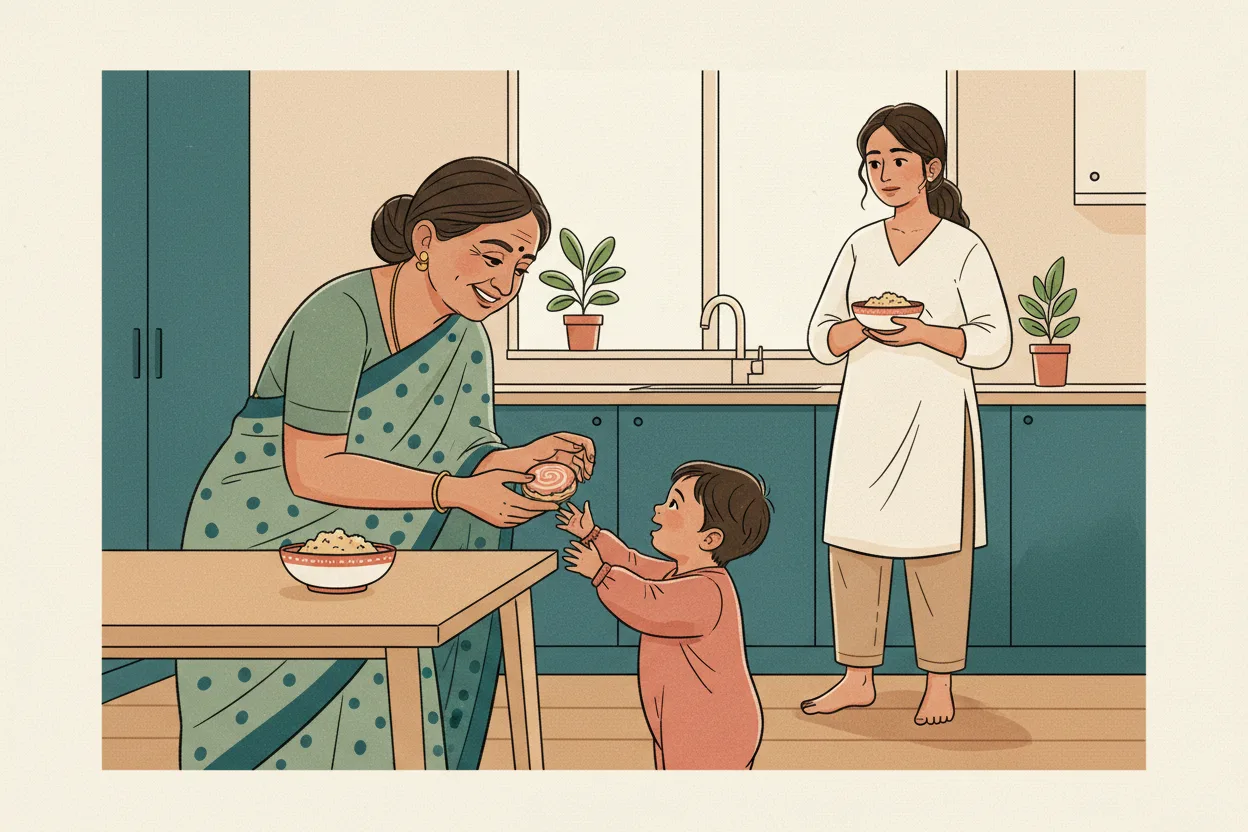
In a lot of Indian homes, a new baby means a steady stream of visitors — grandparents staying for weeks, uncles and aunts dropping by. That's a wonderful support system, and also exactly the setup where two ordinary habits — a smoke break on the balcony, skipping the sink on the way to pick up the baby — become a genuine safety question rather than a minor irritation.
It gets harder when it's a parent, not a stranger, doing it. A father-in-law with decades of smoking behind him isn't going to hear "your hands aren't clean enough" as a small ask, and a partner raised around that same routine may genuinely not see the risk. That gap between "he's always done it this way" and "this baby is different" is the real friction underneath the disagreement.
"He Doesn't Smoke Near the Baby" Isn't the Safety Net It Sounds Like
Smoking on the balcony, in another room, or after the baby is asleep is not the same as skipping exposure altogether. A peer-reviewed NICU observational study (PMC) found that "infants are clearly being exposed to nicotine throughout their time in the NICU, despite smoke-free environments and prohibitions on tobacco/nicotine use" — a strict no-smoking-indoors rule doesn't fully stop exposure, because the person who smoked still carries residue on their hands, skin, and clothes and passes it on through ordinary touch. A separate peer-reviewed study on children's hand-nicotine levels (PMC) found that "the high hand nicotine levels in children whose caregivers do not necessarily smoke indoor demonstrate that indoor smoking bans do not safeguard against THS exposure" — in plain terms, "I only smoke outside" does not make a caregiver's hands safe for a newborn.
This residue is called thirdhand smoke, and it doesn't just sit there harmlessly. A 2023 peer-reviewed review on secondhand and thirdhand smoke (PMC) found that toxic substances from thirdhand smoke "remain on different surfaces even weeks and/or months after smoking," and that the residue reacts with ordinary indoor pollutants to form additional carcinogenic compounds over time. WHO's tobacco fact sheet states plainly that "there is no safe level of exposure to second-hand tobacco smoke" — which is exactly why partial precautions like a balcony smoke break don't add up to safe.
Washing up after a cigarette genuinely helps, but it isn't a full fix either. A randomized controlled study on handwashing and finger-nicotine removal (PubMed) found that handwashing "was more effective than sanitizer for nicotine removal but failed to completely remove nicotine" — so a real soap-and-water wash after smoking lowers the residue a lot more than a quick sanitizer rub would, but it doesn't zero it out, which is one more reason the outer-layer change matters as much as the hand-wash itself.
What Secondhand Smoke Actually Does to a Newborn
Thirdhand residue is the sneaky risk; secondhand smoke — what a baby directly breathes in during or right after someone smokes nearby — is the more familiar one, and it's serious on its own. HealthyChildren.org (American Academy of Pediatrics) states that "infants have a higher risk of SIDS if they are exposed to secondhand smoke." HealthyChildren.org (AAP) states that "in children under 18 months old, secondhand smoke causes up to 15,000 hospitalizations per year in the United States," mostly for respiratory illness and ear infections. A WHO brief on tobacco harms to children states that "children living with smokers are at greater risk for bronchiolitis, pneumonia and other respiratory infections," and links smoke exposure at home to a higher risk of death before age five.
None of this requires the smoker to light up in the same room as the baby — it's the reason "he smokes on the balcony, so it's fine" undersells the exposure a baby in that home is actually getting.
Why Hand Hygiene Isn't a "Nice to Have" Here
Set smoking aside — plain unwashed hands are their own real risk, and this is the rule visitors resist hardest, because it feels like an accusation rather than a precaution. A peer-reviewed study on neonatal hand hygiene (PMC), citing WHO strategy, states that "adequate hand hygiene through hygienic births and clean post-natal care is the cornerstone of the WHO recommended strategies to prevent infection-related newborn death" — it isn't a bonus precaution layered on top of "real" newborn care, it is one of the core things newborn care is built on. That's because a newborn can't fight off germs the way an older child or adult can: a peer-reviewed review on neonatal innate immunity (PMC) found that "the neonatal innate immune response has been considered 'immature,' as functional impairments in phagocytosis and other bactericidal activity as compared to adults have been noted in neonatal innate immune effector cells, such as neutrophils and macrophages" — a newborn's germ-fighting cells simply don't work as well yet.
This isn't only a Western-guidelines rule, either. An Indian evidence-based consensus on neonatal skin care (PMC) states that "hand hygiene (by hand washing or the use of alcohol-based hand rub) should be ensured before handling the neonate" — the same rule, backed by Indian pediatric and dermatology experts, for every single handling of a newborn, not just the first one after arriving.
Secondhand vs. Thirdhand Smoke: What's the Difference?
| Secondhand smoke | Thirdhand smoke | |
|---|---|---|
| What it is | Smoke a baby breathes in directly, during or right after someone smokes nearby | Residue left on a smoker's hands, skin, hair, and clothes, and on surfaces, after smoking |
| "He smokes outside" fix it? | Reduces it, but drifting smoke and re-entry still expose the baby | No — residue travels on the person, regardless of where they smoked |
| How long it lingers | Minutes to hours in the air | Weeks to months on surfaces, fabric, and dust |
| What stops it | Not smoking around the baby at all | Not smoking at all, or a full change of clothes and thorough hand-and-face washing before contact |
Making the Rule Stick Without a Family Blow-Up
There's no need for anyone to admit wrongdoing to enforce this — a specific, consistent routine for everyone works far better than a targeted rule aimed at one relative.
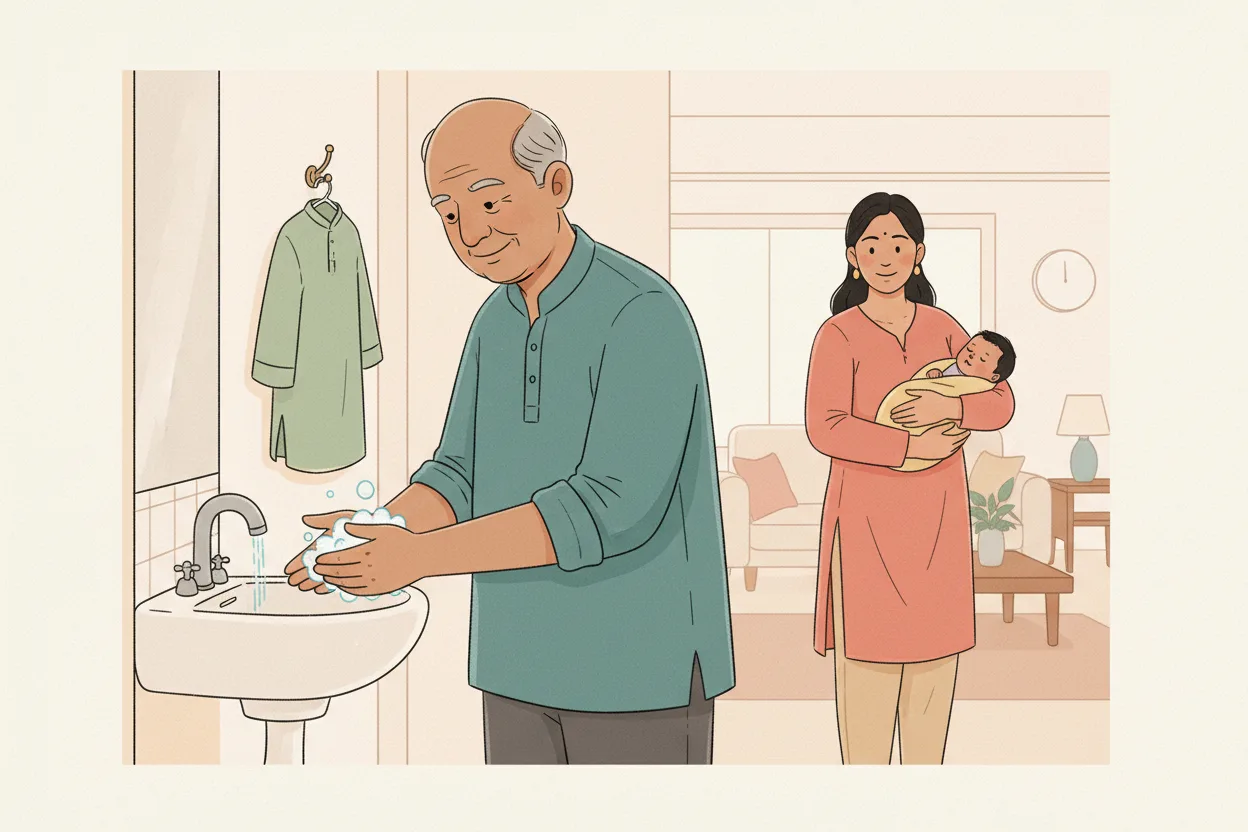
Make it a household rule, not a personal accusation. "Everyone washes hands before holding the baby — that's just our rule right now" is far easier for a proud grandparent to accept than "your hands aren't clean enough." Apply it to yourselves too, visibly, so it doesn't read as singling anyone out.
Give the smoker an easy way to comply. Ask for a full hand-wash with soap and a change of the outer layer (shirt or kurta) after smoking and before picking up the baby — not just a rinse. Keep a spare clean shirt near the door.
Get your partner on the same page privately first. If your partner minimizes the risk, hold off on relitigating it in front of the family. Show them the specific reasoning above and agree on the rule together before either of you raises it with his parents — a united front is far harder to argue with than one parent making the rule alone.
Keep the ask small and physical, not moral. "Wash up first, then come hold her" is a two-second habit, not a judgment on anyone's character. Most relatives will do it without pushback once it's framed that way.
Make the habit obvious. Keep soap and a hand towel — or an alcohol-based hand sanitizer, FirstCry or Amazon.in — right at the entryway, so washing up is the natural first stop, not an extra errand to the bathroom. A sanitizer at the door isn't a lesser substitute here: WHO's Guidelines on Hand Hygiene in Health Care state that an alcohol-based hand rub is "the preferred means for routine hand antisepsis" whenever hands aren't visibly soiled, with soap and water reserved for hands that are visibly dirty — so a visitor who isn't coming straight from a smoke break can sanitize at the door in good conscience.
Frequently Asked Questions
Is it really thirdhand smoke if he only smokes on the balcony? Yes. A peer-reviewed study on children's hand-nicotine levels (PMC) found that indoor smoking bans and smoking away from a child do not prevent thirdhand smoke exposure, because the residue is carried on the smoker's own hands and clothes back into contact with the child.
My in-laws say their hands look clean — is washing really necessary every time? Yes. Visibly clean hands can still carry germs you can't see, and a peer-reviewed study on neonatal hand hygiene (PMC) describes hand hygiene as the cornerstone precaution against infection-related newborn death — precisely because it's protecting against things a quick look at someone's hands won't reveal.
Why does this matter so much more for a newborn than an older baby? A peer-reviewed review on neonatal immunity (PMC) found that newborns have measurably weaker infection-fighting cell function compared with adults — precautions that feel like overkill with a one-year-old are genuinely warranted with a newborn.
My partner thinks I'm overreacting. How do I get them on board? Lead with the balcony-smoking and hand-hygiene facts above rather than emotion in the moment, and agree on the household rule together, privately, before either of you raises it with his parents.