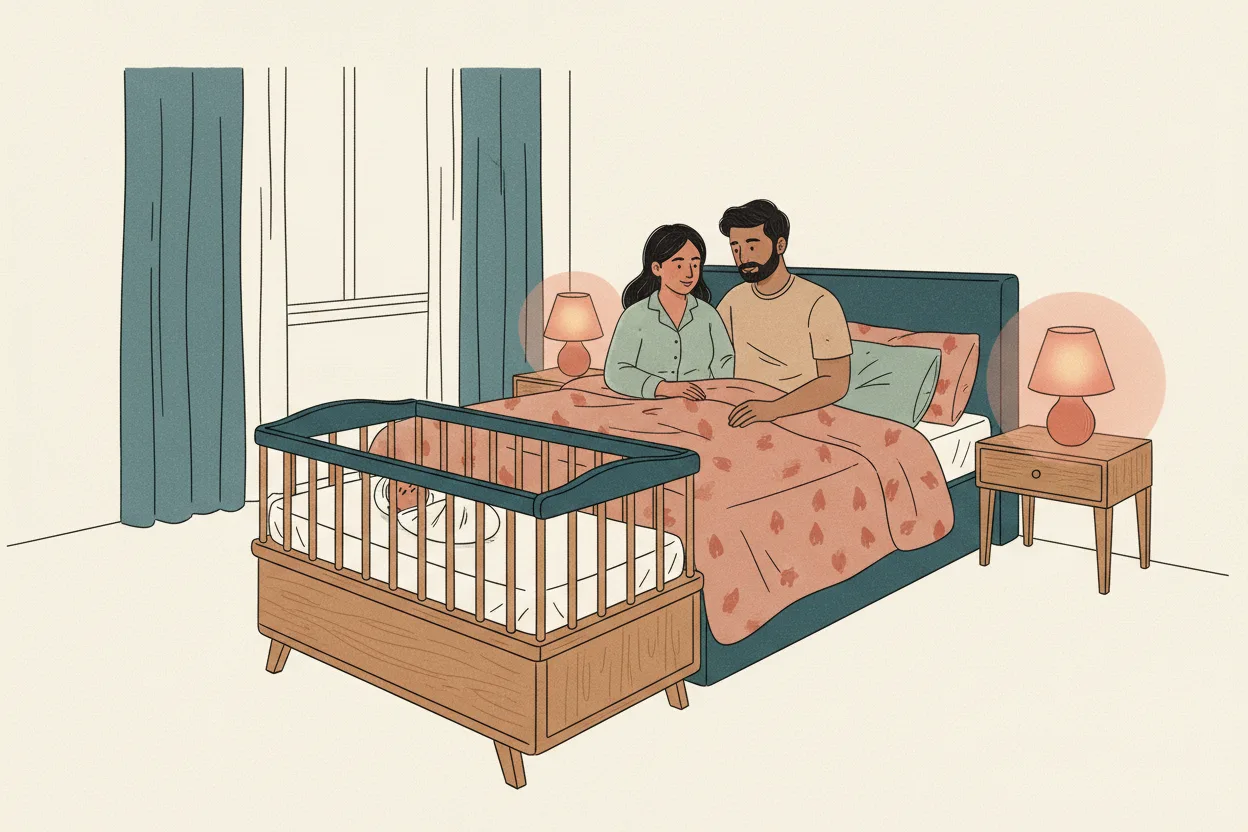


Once your baby can sit up, pull to stand, or rock the frame themselves, the thooli has done its job — it's time to move them to a crib or a firm mattress. The transition is rarely about the furniture; it's about breaking the rocking-to-sleep habit the thooli built, and that takes a plan.
Not medical advice — consult your pediatrician for guidance specific to your baby.
Why This Feels Different for Indian Families
The thooli — a swinging cloth or cane cradle, hung from a hook or stand — is a fixture in most Indian homes with a new baby. Grandparents swear by it, it soothes a colicky newborn fast, and it's genuinely useful for the first several months.
The trouble starts later. A baby who has only ever fallen asleep swinging has learned to depend on that motion, and getting them to sleep any other way can mean a rough few nights of resistance. That's not a parenting failure — it's a well-documented pattern. A 2020 clinical review in Clinical and Experimental Pediatrics describes this as a "child's dependency on specific stimulation, objects, or setting for initiating sleep or returning sleep following an awakening" — and Sleep Foundation lists rocking alongside feeding and lights as one of the most common sleep-onset associations young children form. In a joint household, you'll also likely hear conflicting opinions on when and how to stop — the safety case below is the part that isn't up for debate.
Signs It's Time to Move Out of the Thooli
Baby can climb, pull up, or rock the frame themselves. HealthyChildren.org (AAP) notes that once a toddler can climb out of their sleep space, it's a signal to move them to a safer, stationary one — the same logic applies the moment a mobile baby can tip, over-swing, or climb out of a hanging cradle.
Baby has outgrown the manufacturer's weight or age limit. Most cane and cloth thoolis are rated for young infants only; check the tag or the stand's instructions, since limits vary by product.
Baby is sitting up unsupported. The same firm, stationary-surface standard applies here — a cradle that swings isn't that, once baby is shifting their own weight around inside it.
None of this means the thooli was ever unsafe as a supervised nap or soothing spot for a small infant — but the AAP is clear that overnight and unsupervised sleep needs a stable setup, and a mobile baby who can move around inside a swinging cradle no longer fits that.
The Safety Case for Moving On
AAP's HealthyChildren.org states that babies should always sleep alone in a crib or bassinet, on their back, without soft toys, pillows, blankets, or other bedding — a firm, flat, stationary surface is the standard for every sleep, and a swinging cradle stops meeting that standard once your baby is mobile enough to shift or climb inside it.
This mirrors guidance on other rocking sleep spots. HealthyChildren.org (AAP) advises that if your baby falls asleep in a car seat, stroller, swing, infant carrier, or sling, you should move them to a firm sleep surface on their back as soon as possible, rather than letting them sleep there long-term. Treat an outgrown thooli the same way: a great soothing tool in the moment, not the place for a mobile baby's main sleep.
There's also a specific, documented hazard with the thooli itself once baby starts moving inside it: a 2010 case report in the Journal of Emergencies, Trauma, and Shock found that the cloth sling or cord used to secure a baby in an indigenous rocking cradle can shift onto the neck if an unattended, mobile infant struggles against it — the same report notes this is preventable simply by never leaving baby unattended in the cradle. That risk, on top of the safe-sleep-surface issue above, is the clearest reason to make the move once baby is mobile rather than wait.
Gradual vs Cold-Turkey: Choosing Your Approach
| Approach | How it works | Best for | Timeframe |
|---|---|---|---|
| Gradual (fading) | Shorten swinging time each night; add a consistent wind-down routine (bath, dim lights, story) before placing baby down still; reduce assistance night by night | Babies over 8–9 months, families wanting fewer tears, homes where a grandparent is also adjusting | 1–3 weeks |
| Cold turkey | Stop swinging entirely from night one; go straight to crib/mattress with a firm bedtime routine | Babies under 8 months (before separation anxiety peaks), parents who can commit to consistency without reverting | 3–7 nights of harder resistance, then it settles |
Both approaches use the same tool: a consistent bedtime routine replacing the rocking motion as the sleep cue. A study published in the journal Sleep (Mindell et al., 2009) found that a nightly bedtime routine produced significant improvements in time to fall asleep and in the number and duration of night wakings — and improved maternal mood as a side benefit. Keep the new routine's steps identical every night: same order, same room, same low lighting.
For the resistance itself, a 2006 American Academy of Sleep Medicine practice-parameter review (Mindell et al., in Sleep) found that behavioral approaches such as graduated extinction (checking on baby at increasing intervals) and bedtime fading are strongly evidence-backed, with over 80% of children treated showing clinically significant, lasting improvement. Pick whichever version — checking in every few minutes, or waiting a little longer each night — you and your partner can apply consistently; consistency matters more than which variant you choose.
Timing Around Separation Anxiety
If your baby is between roughly 6 and 18 months, expect the transition to interact with a normal developmental stage. HealthyChildren.org (AAP) explains that beginning in the second half of a child's first year, separation anxiety can cause many nights of disrupted sleep, and this phase typically continues for several months before fading by around the second birthday. That means some resistance to a new sleep setup in this window is developmental, not a sign the crib or mattress is "wrong" — hold the new routine steady rather than reverting to the swing.
What You'll Actually Need
| Item | What to check | Price range | Where to buy |
|---|---|---|---|
| Crib or cot with firm mattress | Slats no more than ~6 cm apart; mattress fits snugly with no gaps | Rs. 5,000 – Rs. 18,000 | Amazon.in / FirstCry |
| Fitted sheet only (no loose bedding) | Snug fit, no soft toys or bumpers inside | Rs. 300 – Rs. 800 | FirstCry |
| Wearable sleep sack | Replaces loose blankets once baby is out of the thooli | Rs. 700 – Rs. 1,500 | Amazon.in |
| Baby motion/sound monitor | Helps you check on baby without going in every time during the fading approach | Rs. 1,500 – Rs. 4,500 | Amazon.in |
If baby currently naps on a mattress on the floor by choice while the thooli was used mainly for overnight sleep, the same firm-surface, no-soft-bedding rule applies there too.
A hanging thooli is usually breezier than a lower, more enclosed crib, so keep an eye on temperature after the move. HealthyChildren.org (AAP) advises keeping the room at a comfortable temperature and dressing baby in layers or a wearable sleep sack rather than loose blankets — a fan or AC on a timer works well for this in most Indian bedrooms, since it avoids both overheating and a stuffy, still room.
Frequently Asked Questions
My baby only sleeps if the thooli is swinging. Will she ever sleep still? Yes — this is a sleep-onset association, a well-recognized and common pattern, and it responds well to a consistent bedtime routine plus a gradual or cold-turkey approach. Expect a rough few nights, not a rough few weeks, if you stay consistent.
Is it unsafe to keep using the thooli once baby can sit up? Once your baby is mobile enough to shift their weight, climb, or rock the frame themselves, AAP guidance on moving to a safer, stationary sleep surface applies — a swinging cradle is not designed to be a stable base for a mobile baby's overnight sleep.
My mother-in-law says the thooli soothes colic and I shouldn't stop yet. She's right that it soothes a young infant well. The transition is about overnight, unsupervised sleep once baby is mobile — daytime supervised soothing in a swing is a separate question from where baby sleeps at night.
Should I do gradual or cold turkey? Both are backed by strong evidence for behavior change. Gradual fading suits babies past about 8–9 months (once separation anxiety is more active) and families who want fewer tears; cold turkey tends to work faster for younger babies. Either way, a consistent nightly routine is the piece that matters most.
How long will the adjustment take? Most families see real improvement within one to three weeks, with over 80% of children in controlled studies showing lasting improvement. If nothing has changed after three to four weeks of a consistent approach, talk to your pediatrician.
What if she wakes at night and cries for the swing again? This is common, especially during the separation-anxiety window. Comfort her briefly without picking up the swinging motion again — a hand on the back, a few quiet words — then let her resettle in the crib or mattress.