

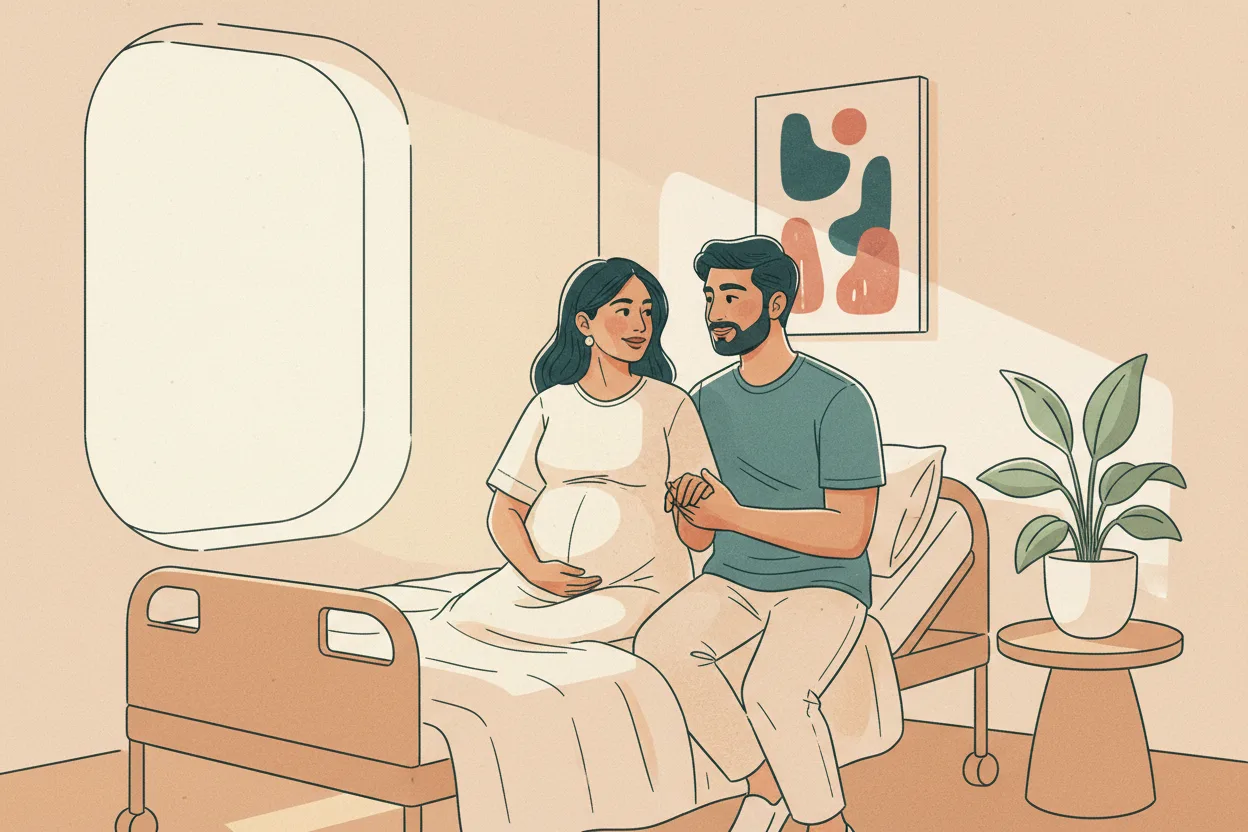
A planned twin C-section is a scheduled, well-rehearsed surgery on a date your obstetrician sets in advance. Most of the anxiety around it comes from not knowing exactly what will happen and when, so this guide walks through the actual sequence: the surgery itself, the recovery room, the hospital stay, and the first feeds, plus what genuinely helps with pre-surgery nerves.
Not medical advice — talk through your specific case with your obstetrician.
Why Twins Change the Timeline
If you're carrying twins with their own separate placenta and amniotic sac each (di-di twins) in an uncomplicated pregnancy, NIH's StatPearls states that "delivery can be planned between 38 0/7 and 38 6/7 weeks" — earlier than the 39–40 weeks many singleton pregnancies go to. Your obstetrician isn't rushing things; they're following the standard timeline for twins.
Your OB team also has one specific thing on their radar that's more common with twins than with a single baby: a study on postpartum hemorrhage risk factors in twin cesarean deliveries (published via NIH's PMC) found that "in twin gestations, the uterine overdistension is quite common and it is an important contributor to uterine atony" — the uterus has stretched to hold two babies, so it can be slower to contract firmly after delivery. That's why your team watches your bleeding closely for the first hour or two — routine, planned-for monitoring, not a sign of trouble.
Eating and Drinking Before Surgery
One concrete, practical worry parents often forget to ask about: when do you actually have to stop eating and drinking? The Indian Society of Anaesthesiologists' practice guidelines (published via NIH's PMC) state that "clear liquids should be allowed up to 2 h prior to administration of sedation or anaesthesia. Light meals may be allowed up to 6 h prior to administration of sedation or anaesthesia." These same limits apply to pregnant patients, so confirm your hospital's exact cutoff times with your OB team the day before so you can plan your last meal and last sip of water accordingly.
What Actually Happens in the Operating Room
For a planned C-section, you'll almost always be awake. ACOG explains that with a spinal block, "medication numbs the lower half of your body. You receive it the same way as an epidural block, but the drug is injected directly into the spinal fluid." You won't feel pain, though you may feel pulling or pressure — twins are usually born a minute or two apart through the same incision.
Having your partner beside you at the head of the table is standard practice at most hospitals for planned C-sections, and it isn't just company. A study on partner presence at cesarean sections (published via NIH's PMC) notes that partner presence "reduces the mother's anxiety, cements the father's role in childrearing, and reflects current occupational positions on patient autonomy." Confirm your hospital's policy at a prenatal visit rather than assuming.
Recovery Room and Hospital Stay Reality
After surgery, you'll move to a recovery area for close monitoring before going to your room. The NIH's MedlinePlus Medical Encyclopedia states that "most women will remain in the hospital for 2 to 3 days after a C-section" — with twins, your team may keep you on the longer end of that window simply to keep an eye on both babies and your recovery together.
Two things will happen early that surprise a lot of first-time parents:
You'll be encouraged to get up and walk, often within a day. The NHS advises that patients "try to stay mobile and do gentle activities, such as going for a daily walk, while you're recovering to reduce the risk of blood clots." It will feel uncomfortable the first time — that's normal, and the nurses will help you up slowly.
Antibiotic timing matters more than you'd think. A study on antibiotic prophylaxis among Indian women undergoing cesarean sections (published via NIH's PMC) found surgical site infections "occurring in 3% of timely cases versus 9% in delayed cases." It's your hospital's protocol to manage, but worth confirming with your OB that antibiotics are given on schedule.
| Recovery milestone | What to expect |
|---|---|
| Hours 0–2 | Recovery room, close monitoring, first skin-to-skin if both babies are stable |
| Day 1 | First assisted walk, catheter typically removed, pain managed with scheduled medication |
| Day 2–3 | More independent movement, both babies rooming in if stable, discharge planning begins |
| Discharge | Typically day 2–3 post-surgery, longer if either baby needs extra monitoring |
Once You're Home: Warning Signs and Activity Restrictions
Knowing exactly what's normal versus what needs a call to your doctor removes a lot of guesswork once you're managing two newborns at home. The NIH's MedlinePlus Medical Encyclopedia states that you should contact your provider for "fever more than 100°F (37.8°C) that persists," "redness, warmth, swelling, or drainage from your incision site, or your incision breaks open," or vaginal bleeding "that is still very heavy (like your menstrual period flow) after more than 4 days." None of these are common, but knowing the exact thresholds means you don't have to guess whether what you're seeing counts as "worse than expected."
Getting back to daily activity also follows a general pattern. Cleveland Clinic states that "most providers recommend avoiding steps, lifting, exercise and other strenuous activities for several weeks," and that "your provider may put restrictions on driving until you're able to turn your body and apply pressure to the pedals with ease." In a multi-generation household, this is worth planning around explicitly — it's a reasonable ask to have an older sibling picked up and carried by a grandparent or partner rather than by you for the first several weeks, and to leave driving to someone else until your OB clears you at a follow-up visit.
Calming the Pre-Surgery Anxiety
Feeling anxious before a scheduled surgery is normal — and there's real evidence that preparation helps more than reassurance alone. A quasi-experimental study on educational sessions before cesarean section (published via NIH's PMC) found that "providing proper preoperative education about CSs can reduce preoperative anxiety, improve patient outcomes, and enhance patients' involvement in their care." In practice, that means asking your OB team specific questions at your pre-surgery appointment rather than leaving them unanswered:
- Which staff will be present in the operating room, and whether your partner can stay the whole time
- What the spinal block will feel like as it takes effect
- Whether skin-to-skin will happen in the OR or the recovery room
- What the first 24 hours with two newborns and a fresh incision will actually look like on the ward
Walking in with clear answers to these does more for anxiety on the morning of surgery than trying not to think about it.
A breathing-based relaxation technique can help alongside that preparation, not instead of it. A randomized controlled trial on relaxation techniques before cesarean section (published via NIH's PMC) found that "although both of the BRT and MT helped with the reduction of anxiety among primiparous women before cesarean section, the BRT was shown more effective." The Benson technique itself is simple: breathe in slowly through your nose, breathe out through your mouth while silently repeating a calming word, and hold a comfortable position for a few minutes. It's worth practicing in the days before surgery so it's already familiar on the morning of.
First Feeds and Skin-to-Skin
Many parents worry that a C-section will delay bonding or breastfeeding. It doesn't have to. The AAP's HealthyChildren.org states that "even with a C-section delivery, you can still hold your baby close right away as long as the baby are healthy and stable" — with twins, this usually means one baby skin-to-skin with you and the other with your partner, so neither waits.
Once you're settled, feeding position matters because of the incision. The AAP's HealthyChildren.org recommends "sitting up in bed, using one or two extra pillows to support your baby on your lap and protect your incision, by lying down on your side with your baby facing you, or by using a football hold with enough pillows to raise your baby's head to the level of the breast." With twins, the football hold on both sides at once (tandem feeding) is worth asking a lactation consultant to show you before you leave hospital — it keeps both babies' weight completely off your scar.
Pain Management While Breastfeeding
You do not have to choose between managing pain and breastfeeding. ACOG advises that "ibuprofen is usually the preferred first step because little of it passes through breastmilk. Acetaminophen also is safe to take while breastfeeding," with a short course of a stronger prescription option available if needed. Take pain medication on schedule rather than waiting until pain builds — staying ahead of it makes the first walk and first feeds easier.
Hospital Bag and Practical Prep
Beyond the standard hospital bag basics, a twin C-section stay benefits from a few specific things:
| Item | Why it helps | Where to buy |
|---|---|---|
| High-waisted, soft cotton postpartum underwear | Sits above the incision line, avoids rubbing | Amazon.in / FirstCry |
| Twin nursing pillow (double C-shaped) | Supports both babies for tandem football-hold feeds | FirstCry |
| Front-opening nightgowns, 2–3 | Easy skin-to-skin and feeding access without lifting over the incision | Amazon.in |
| Small step stool | Helps you get in and out of a high hospital or home bed without straining the scar | Amazon.in |
Frequently Asked Questions
How early are twins typically delivered by planned C-section? For uncomplicated di-di twins, NIH's StatPearls states delivery is typically planned "between 38 0/7 and 38 6/7 weeks." Your own date depends on your specific pregnancy — confirm the plan with your obstetrician.
Will I be awake during the surgery? Yes, for a planned C-section you'll typically have a spinal block. ACOG explains it "numbs the lower half of your body" while you stay awake and alert for the birth.
Can my partner be in the operating room? At most hospitals, yes, for a planned procedure — and research links partner presence to lower maternal anxiety around the surgery. Confirm your specific hospital's policy with your OB in advance.
How long will we be in the hospital? Most patients stay 2 to 3 days after a C-section; with twins your team may lean toward the longer end so both babies can be monitored before discharge.
Can I hold and feed both babies right after birth? Skin-to-skin is possible right after a C-section as long as babies and parent are stable — with twins, this often means splitting skin-to-skin between you and your partner so neither baby waits.
What actually helps with the anxiety before surgery? Structured preoperative education measurably reduces anxiety more than avoidance does. Ask your OB team the specific questions above at your pre-surgery appointment rather than going in with unanswered ones.