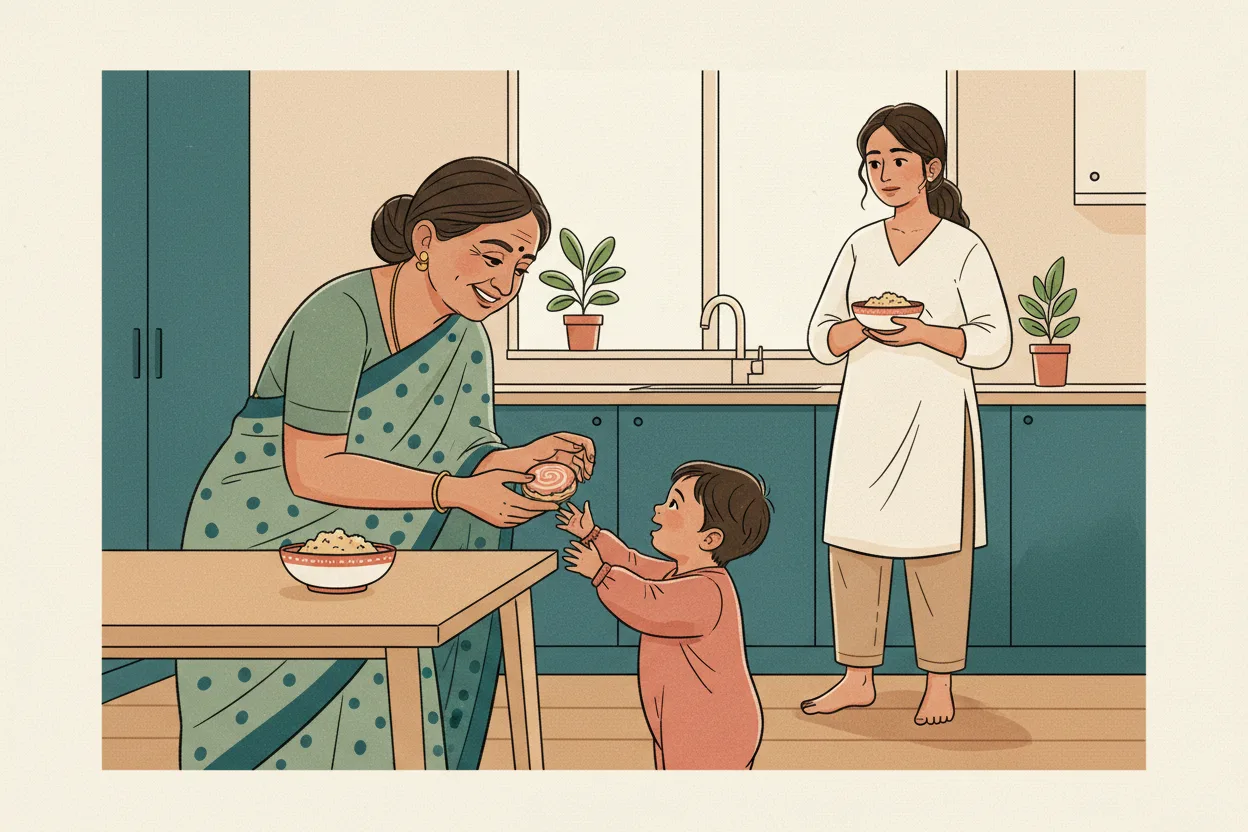


Taking help from your in-laws doesn't make you less capable, and turning it down doesn't make you more independent. The question that matters is narrower: does this help protect your sleep and give real support, without taking your decisions away from you? Answer that, and the "village vs. going it alone" debate mostly sorts itself out.
Not medical advice — consult your doctor or a mental health professional for guidance specific to your situation.
Why This Decision Is Bigger Than It Looks
This isn't just a logistics question about who does the night feed or who cooks. A systematic review and meta-analysis of postpartum depression studies across India found a pooled prevalence of about 24% among urban Indian mothers — roughly one in four. Whatever you decide about family help, this is a real, common risk you're weighing, not a hypothetical one.
A peer-reviewed study of postpartum women found that women with low composite social support had six times the odds of postpartum depressive symptoms compared to those with strong support (aOR = 6.1). Support is one of the biggest levers on your mental health in the first months.
Sleep is the other half of the equation. A clinical review of sleep and perinatal mood disorders found that insomnia symptoms carry significant risk for new-onset depression and anxiety disorders. Whatever arrangement you choose — full-time family help, occasional help, or none — the real test is whether it protects your sleep, not whether it "looks like" independence or "looks like" tradition.
There's a practical safety angle too. WHO's postnatal care recommendations state that a home visit within the first two days after birth, where feasible, is critical to reducing mother and newborn mortality and morbidity. Whoever is around in that first week — family, a nurse, a lactation consultant — having eyes on you and the baby early is part of safe recovery, not optional.
What the Evidence Actually Says About In-Law Help
This is the part most decision-making around "the village" skips: does having in-laws around actually help or hurt a mother's mental health? Two Indian studies point the same direction, with a caveat.
A cross-sectional study at a tertiary care center in Eastern Uttar Pradesh, India found that 70.6% of women in the depressed group did not have an adequate relationship with their in-laws, and that inadequate in-law relationships significantly increased the risk of postpartum depression (p = 0.001). Separately, a study of postpartum mothers in Aurangabad, Bihar, India found that healthier relationships with partners and in-laws were both associated with lower depressive symptoms.
The caveat is in the word "healthier." Neither study says living with in-laws is protective by itself — the Bihar study specifically found that it's the quality of the relationship with in-laws that tracks with lower depressive symptoms, not simply their presence in the home. That's the actual decision in front of you: not "family help, yes or no," but "is this specific relationship, with these specific people, one that leaves me feeling supported or one that leaves me managing conflict on top of a newborn?"
The Bonding Worry: Will Baby Get Too Attached to Grandma?
A common fear that keeps mothers from accepting hands-on help is that it will weaken their own bond with the baby. The attachment research doesn't support that fear. A NICHD-funded longitudinal study of early child care found that children can form secondary attachment relationships with non-familial child care providers, which may be beneficial — and a loving grandparent is a far closer, more consistent figure than that. A baby forming a secure bond with a grandmother doesn't come at the cost of the bond with you; babies form multiple secure attachments at once.
Where the Father Fits — Not a Third Option, the Best One
Before framing this as "in-laws vs. going it alone," there's a third form of support already in the house: the baby's father. A randomized controlled trial found that training fathers to be hands-on with infant care from the first hours after birth strengthens father-infant bonding, reduces maternal postnatal depression risk, and improves postnatal quality of life. A father genuinely doing the 2am feed and nappy changes — not "helping out" but sharing the load as a parent — is one of the best-evidenced forms of support available, without any of the boundary questions that in-law help can bring.
What "Going It Alone" Actually Buys You
Independence has a real upside: full control over your routines, no visitors to manage, no second opinions on feeding or settling the baby. For mothers whose family relationships are tense, that predictability can itself protect mental health — the "healthier relationship" finding above, working in reverse.
What going it alone doesn't automatically buy you is rest. A qualitative study of postpartum women in Punjab, India found that mothers described being able to physically rest and recover specifically because mothers-in-law and mothers took over household chores and newborn care — one put it simply: "At my mother's place, there was no such work to do. Your mother does the work." Going it alone means that recovery time has to come from somewhere else: a paid helper, a postpartum doula, or a partner genuinely splitting the load in half.
A Decision Framework, Not a Verdict
| If this describes your situation... | Consider... |
|---|---|
| Relationship with in-laws is warm; you feel heard when you set a boundary | Accept hands-on help — the evidence favours it for your sleep and mood |
| Relationship is currently strained or one-sided | Time-boxed help (e.g., first 2–4 weeks only) with clear ground rules |
| In-laws are supportive but override your parenting choices | Keep the help, but have your partner run interference on decisions |
| No family help is available or wanted | Build a substitute: partner sharing night feeds, a paid postpartum helper, or a doula for the first weeks |
| You feel guilty either way | Guilt isn't a reliable signal — weigh sleep, mood, and relationship quality instead |
Neither "have family help" nor "go it alone" is, by itself, what the research supports. What predicts a better outcome is support that comes with a good relationship and real rest — whether that support wears a sari or a work badge.
Frequently Asked Questions
Does it mean something is wrong with me if I want to raise my baby without my in-laws' daily involvement? No. Wanting your own space is a legitimate preference, not a parenting failure. The Bihar study ties better outcomes to relationship quality and rest, not to whether extended family lives in the house.
Will my baby bond less with me if my mother-in-law does a lot of the caregiving? Attachment research shows babies can form secure secondary attachments to consistent, loving caregivers without it displacing their bond with their mother. Your bond isn't a fixed quantity that gets divided among caregivers.
How do I know if accepting help is actually helping or just adding conflict? Track it honestly for two weeks: are you sleeping more, and do you feel supported after a disagreement, or steamrolled? Poor sleep and an inadequate in-law relationship are both independently linked to higher depression risk — if either is trending the wrong way, change the arrangement rather than endure it.
My in-laws want to move in for the first month. Is that too much? There's no universal answer, but WHO flags the first two days as a critical window for a mother and newborn to be closely looked after. A time-boxed stay for the first few weeks, with an agreed end date, gets you the early safety-net benefit without an open-ended commitment.
What if my husband says he wants to handle things without his parents' help? Worth taking seriously, especially if he's genuinely hands-on with night feeds and daily care rather than just saying so. A father actually sharing the load is one of the best-evidenced forms of postpartum support there is.