
You can visit a relative's home that isn't as clean as yours and still keep your baby safe — a handful of specific habits do most of the work, and there's no need to say a word about anyone's housekeeping to put them in place. The rest is about picking your moments and being clear, kindly, about what your baby needs.
Not medical advice — consult your pediatrician for guidance specific to your baby.
Why Your Baby Is More Vulnerable Than You Are
It isn't your imagination or overprotectiveness. AAP's HealthyChildren.org explains that newborns have higher chances of getting sick from viruses and bacteria than older children and adults, because their immune systems haven't yet learned how to resist most infections. That's true whether the house you're visiting is spotless or lived-in — a baby's defenses are simply still under construction.
This matters more for some illnesses than others. A review in PMC explains that newborns' increased susceptibility to severe disease from respiratory viruses comes down to their naive immune status. A cousin's toddler with a runny nose, or an uncle nursing a cold, is a bigger deal for your baby than it would be for you.
None of this means avoiding family. It means a few targeted habits travel with you, wherever you go.
The Habits That Actually Matter on a Visit
There's no need to inspect anyone's kitchen. You need control over the things that touch your baby directly.
Hands before baby, every time, no exceptions. Nemours KidsHealth advises that it's especially important to wash hands before holding or caring for an infant, toddler, or elderly person. Keep a small bottle of hand sanitizer next to wherever baby is sitting, and offer it to whoever reaches for the baby — "here, use this first" reads as thoughtful, not accusatory.
Handwashing is worth the fuss it seems like. A WHO evidence review found that handwashing promotion reduced diarrhoea incidence by around a third in the settings studied. That's not a small effect for something as simple as soap and water before a feed or a nappy change.
A sick relative should sit this one out, hands or no hands. The Lullaby Trust advises that people who are ill or have been ill recently — including cold sores, diarrhoea, or vomiting illnesses — shouldn't visit a baby at all, no matter how careful they are about washing up first. If an aunt or cousin mentions they're "just getting over" something, it's reasonable to ask them to hold off meeting the baby until they've fully recovered rather than have them handle hand sanitizer instead.
Vaccinated adults are the real cocoon around your baby. Washington State Department of Health advises that parents, siblings, grandparents, and anyone else who'll be around your baby regularly should be up to date on routine vaccines, ideally at least two weeks before meeting the baby so their immunity has time to build. It's a reasonable, low-friction ask to make of frequent visitors — checking on a flu shot or Tdap booster is a much smaller conversation than asking someone to change their hygiene habits.
Clean the surface you change baby on. You're likely changing baby on a guest bed, a sofa, or a mat someone hands you — not your own changing table. AAP's HealthyChildren.org recommends cleaning the area after each diaper change, including the changing surface itself. Carry a wipeable travel changing mat and surface wipes, and use them every single time regardless of how clean the room looks.
Breastfeeding keeps working for you here too. If you're breastfeeding, a systematic review in PMC found that breastfeeding protects infants against overall infections, including gastrointestinal and respiratory tract infections — exactly the kind of exposure a busier household brings. Feed on your own terms, whenever baby needs it, rather than waiting until you're home.
Protecting Sleep When You're Not on Your Own Bed
Family visits often mean naps happen somewhere unfamiliar — a spare room, a sofa, someone's bed while the grownups are in the next room. NICHD's Safe to Sleep campaign recommends that soft surfaces such as couches, sofas, waterbeds, memory foam, air and pillow-top mattresses, quilts, thick blankets, and sheepskins are not safe for babies to sleep on — and that holds just as true away from home as in your own nursery.
Carry your own firm, flat sleep surface when you travel — a travel bassinet or a firm portable crib mattress you trust — and use it for every nap and every night, even a short overnight stay. It's worth packing even when luggage space is tight.
When a High-Needs Baby Gets Overwhelmed at a Gathering
A family function is loud: multiple conversations, new faces wanting a turn holding the baby, sudden bursts of laughter or firecrackers outside. Healthline reports that some babies get overwhelmed by noisy, crowded, brightly lit, or colorful places. If your baby is more sensitive to this than most — turning their face away, arching, crying without an obvious trigger — that's a real response to the environment, not a behavior problem.
Plan an exit route before you arrive: a quieter room you can retreat to for ten minutes, a carrier or sling so you can step outside for air without a production, and an agreement with your partner on whose turn it is next to hold or soothe baby. Naming this out loud to the host in advance — "we'll probably duck into a side room if baby gets fussy, nothing personal" — heads off any hurt feelings later.
Saying It Without Starting a Fight
The hygiene habits above solve most of the actual risk quietly, without a conversation at all. For the handful of things you do need to say out loud — please wash your hands before holding the baby, we're going to use our own mat for nappy changes, we'll step out if baby gets overstimulated — frame them as things you're doing for baby, not corrections aimed at the house. "Baby's paediatrician wants us doing this for the first few months" carries the same boundary with none of the friction, and it has the advantage of being true.
Pick your moments. There's no need to lay out every rule at the door — introduce each habit naturally, in the moment it's needed, and most relatives adjust without anyone needing to discuss it directly.
What to Pack for a Family Visit
| Item | Why it matters | Price Range | Where to Buy |
|---|---|---|---|
| Travel changing mat (wipeable) | Gives baby a clean surface anywhere, independent of the house | Rs. 400 – Rs. 900 | Amazon.in / FirstCry |
| Hand sanitizer, travel-size (for guests to use) | Makes "wash your hands first" an easy ask, not an awkward one | Rs. 100 – Rs. 250 | Amazon.in |
| Firm travel bassinet or crib mattress | Keeps every nap on a safe, flat surface away from home | Rs. 1,500 – Rs. 4,500 | FirstCry / Amazon.in |
| Baby carrier or sling | Lets you step away from a crowded room without fuss | Rs. 1,200 – Rs. 3,500 | Amazon.in / FirstCry |
| Surface disinfectant wipes | Quick clean of any changing or feeding surface on arrival | Rs. 150 – Rs. 350 | Amazon.in |
Frequently Asked Questions
Is it rude to bring my own mat and wipes to someone's house? No. Most relatives read it as good preparation, not an insult — you'd pack the same things for any outing with a baby this age. Keep it low-key and it won't come across as a judgment on their home.
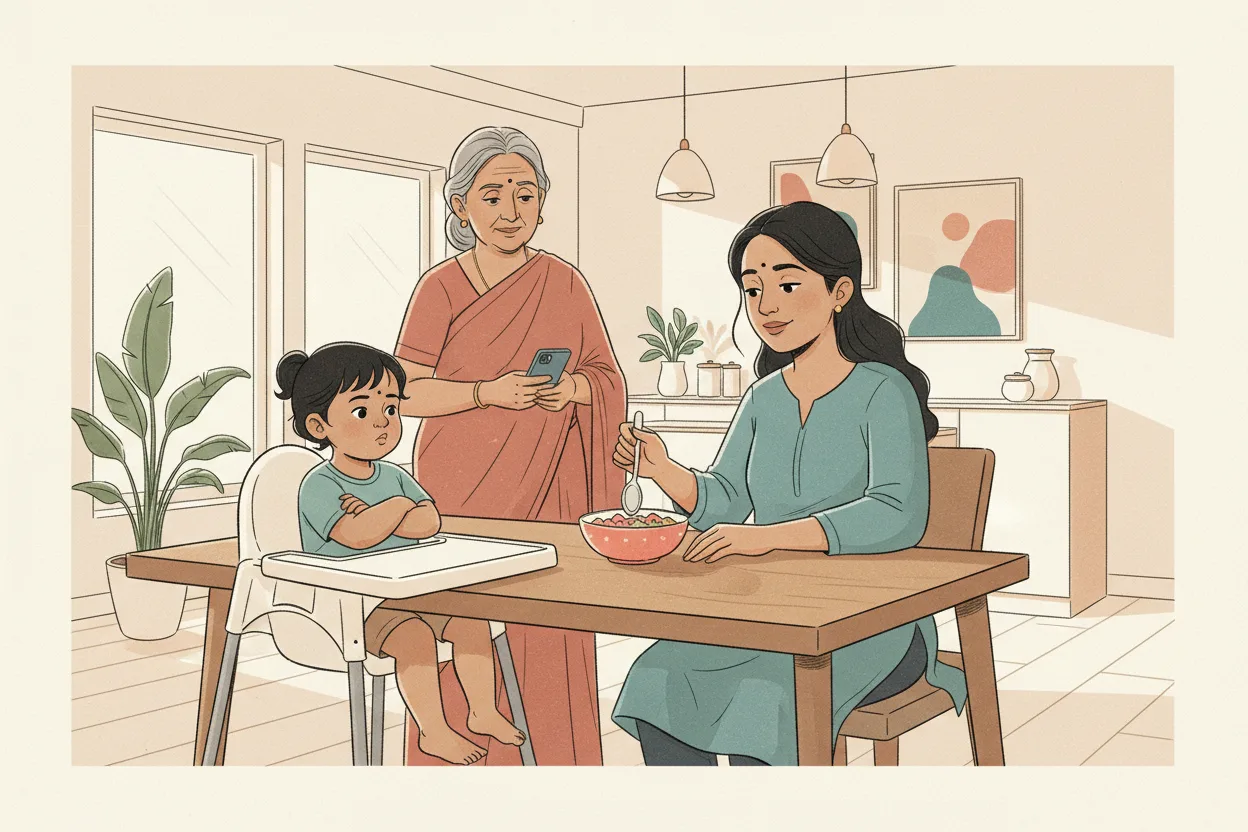
My mother-in-law says I'm being paranoid about hand-washing. How do I hold the line? There's no need to argue the science — just keep it simple and consistent. Offering the sanitizer bottle yourself, every time, to everyone including yourself, makes it feel like a routine rather than a rule aimed at any one person.
Can I breastfeed at a family gathering instead of waiting until we're back home? Yes — feeding on your own schedule, wherever you are, is one of the more protective things you can do for baby in an environment with more people and more germ exposure than home.
What if there's nowhere quiet to put the baby down for a nap? Bring your own firm, flat sleep surface (a travel bassinet or a mattress you trust) rather than using a sofa, guest bed with soft bedding, or someone's lap. If truly nothing suitable is available, it's reasonable to keep the visit shorter and time it around your baby's nap schedule.
How do I tell if my baby is genuinely overstimulated versus just fussy? Watch for baby turning their face away, arching their back, or crying that doesn't ease with the usual soothing — these point to the environment being too much, rather than hunger or tiredness alone. Stepping into a quieter room for a few minutes is usually enough to reset.
Should I skip family visits entirely until baby is older? Not necessarily — with the habits above in place, most healthy full-term babies can visit family safely. If your baby was born premature, has a health condition, or you're simply not comfortable yet, it's fine to wait and let people visit you instead for the first few months.