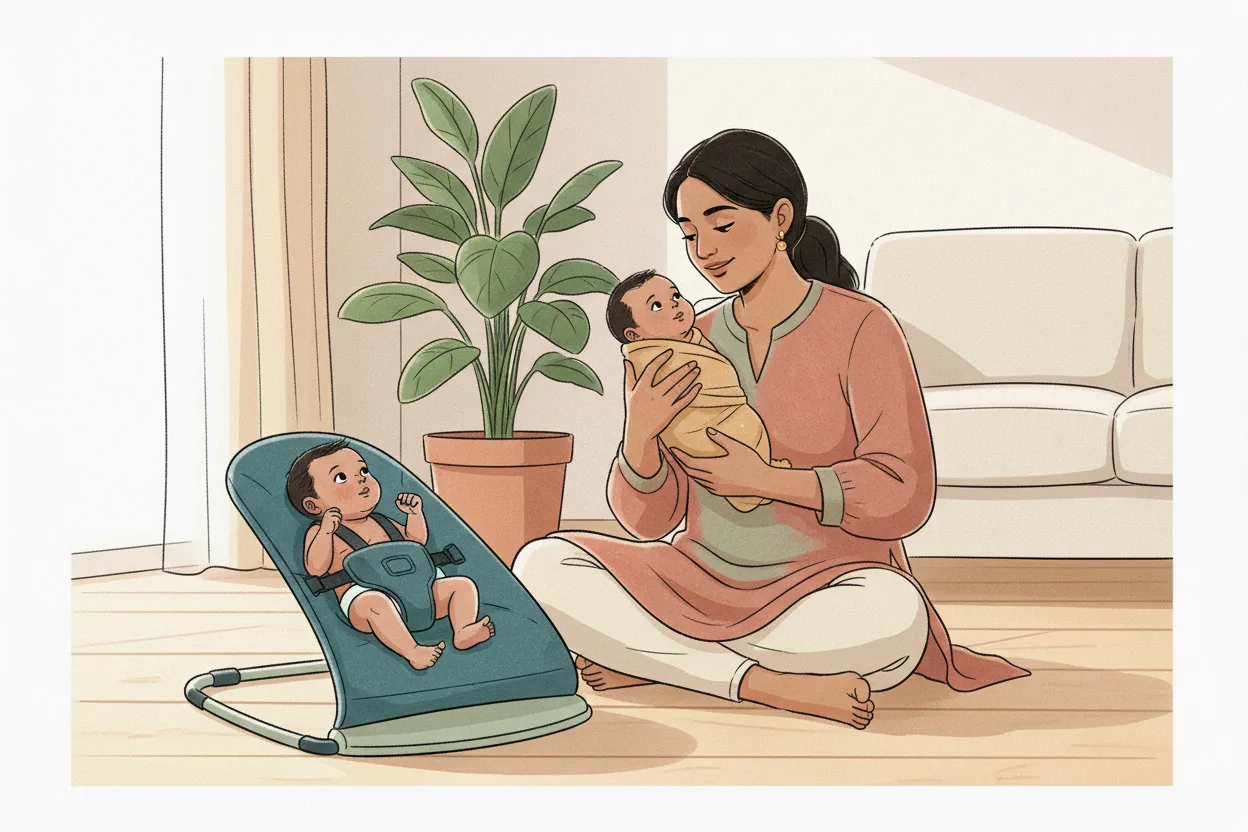
A bouncer or rocker is a seat for supervised, awake time. That is genuinely useful — twenty minutes with your hands free and a baby who can see you. It is never a bed. The AAP explains that swings, rockers and bouncers hold a baby upright or inclined, and that this causes the baby's head to fall forward or sideways if they fall asleep, making it hard or even impossible for them to breathe.
So the rule is one sentence long: if the baby falls asleep in it, take them out. The AAP advises that if a baby dozes off in a car seat, stroller, swing, carrier or sling you should move them to a firm sleep surface on their back as soon as possible, and that sleep belongs on a firm, flat surface. The NIH's Safe to Sleep campaign puts it the same way: sitting devices are not recommended as a baby's regular sleep or nap space, and a baby who falls asleep in one should be moved to their regular sleep space as soon as possible.
Not medical advice — consult your pediatrician, and for babies born early, your neonatologist.
Bouncer, rocker, swing: what you are choosing between
The words get used interchangeably in Indian shops and listings. All three are reclined seats; what varies is what moves them.
| Product | What moves it | Is it a sleep surface? |
|---|---|---|
| Bouncer | Baby's own kicking, or a nudge from you; some add vibration | No |
| Rocker | A curved base or rocking frame | No |
| Swing | A motor swinging the seat front-to-back or side-to-side | No |
A bouncer is the lightest and cheapest of the three and folds flat, which is why most families end up with one. None of them is a cot.
Preterm babies are exactly the group that rule was written for. The NIH's Safe to Sleep campaign lists babies born before 37 weeks of pregnancy, and babies of low birth weight, among those at higher risk of SIDS — and a baby with a corrected age of a couple of weeks has barely any neck strength, which is the same mechanism the AAP describes. A bouncer is not dangerous because it rocks. It becomes dangerous the moment it is used as a bed.
What happened when products blurred that line
The US Consumer Product Safety Commission warned in April 2019 that it was aware of 10 infant deaths in the Fisher-Price Rock 'n Play since 2015, after the infants rolled from their back to their stomach or side while unrestrained. A week later it was recalled. The CPSC's recall notice records about 4.7 million units, and that over 30 infant fatalities had occurred in Rock 'n Play Sleepers since the product launched in 2009.
The response ended the category rather than tightening it. Under the US Safe Sleep for Babies Act, the CPSC states that from 12 November 2022, regardless of date of manufacture, inclined sleepers for infants — a product with an inclined sleep surface greater than 10 degrees — are banned hazardous products. Separately, the CPSC's infant sleep products rule requires that anything sold for infant sleep must not have a seat back or sleep surface angle exceeding 10 degrees.
You will not see a recall notice in an Indian shop or marketplace listing, which matters most for a hand-me-down. One arriving from a cousin or an apartment-group resale comes with no paperwork, so the check falls to you: find the exact model name on the label, then look it up against the manufacturer's own page and recall listings before use. Our guide to buying second-hand baby products safely covers the rest.
Do you need to hold them upright for 20 minutes after a feed?
Answer this first: if the answer is no, your back problem is solved without buying anything.
The NHS says reflux in babies is very common and usually gets better on its own, and it does suggest holding your baby upright during feeding and for as long as possible after feeding. So the instinct is not wrong. Notice what it does not contain, though: a number. There is no official twenty-minute figure to hit, and "as long as possible" means something different with two newborns and one pair of arms.
The seat is the part that does not substitute. The AAP answers directly that a semi-inclined position does not make reflux better, that there is evidence it can make reflux worse, and that car seats and other sitting devices like swings or reclined bouncy seats are not safe sleeping environments. The measurements agree: a 2023 pilot study placed infants at 0, 10, 18 and 28 degrees of head elevation and found brief episodes of hypoxia and bradycardia as well as observed regurgitation were common, with no differences in outcomes at the various degrees. Small and exploratory — but no benefit from propping a baby up.
So "upright" means against your shoulder, not reclined in a seat. A bouncer is a fine place for a fed, awake, content baby while you deal with the other one; it is not a reflux treatment. And because your twins came early, a group the NIH puts at higher risk, any positioning instruction from their neonatologist beats anything general, including this page.
Using one safely: four habits
The safety record is specific about how bouncers actually hurt babies, and it is not the bouncing. The CPSC reports that the major cause of reported bouncer fatalities was suffocation when unrestrained babies turned over in a bouncer, and that required labels tell caregivers to use the bouncer only on the floor, to always use the restraints adjusted to fit snugly, and to stop using it when the baby starts trying to sit up.
In practice: harness fastened snugly every single time; the bouncer on the floor, not on a bed, sofa, dining table or counter; short sessions rather than a parking spot for the morning; and the manufacturer's printed weight and age limits respected rather than estimated.
Two babies and one adult
The Lullaby Trust advises following safer sleep advice for each baby at every sleep, and that once babies can roll and move about the cot they need separate sleep spaces. That means two flat sleep spaces — two cots, two bassinets, whatever your room allows — plus brief, supervised bouncer time for the twin who is waiting.
A feed cycle that works: feed baby A, hold A on your shoulder while B waits harnessed in the bouncer where you can see them, then swap. The bouncer earns its place as the safe waiting room, not the bed. If one twin has started refusing the cot and will only sleep held, that is a separate problem with its own answer — see getting a baby into the crib without waking them.
What to look for when you buy one
No brand rankings, and no prices that will be wrong next month. Judge the unit in front of you.
| Criterion | What you want |
|---|---|
| Harness | A 3-point or 5-point harness you can tighten, not a lap strap |
| Recline | Clearly a seat; flatter settings are for comfort, not a licence to let them sleep |
| Stability | Wide base, low centre of gravity, no wobble when you push the seat |
| Build | No sharp edges or pinch points at the fold; frame locks open positively |
| Cover | Removable and machine-washable |
| Limits | A printed weight limit and a clear "stop using when" marker |
| Standard | Stated conformity to a recognised infant bouncer standard |
On that last row: the CPSC's bouncer-seat standard, 16 CFR part 1229, covers performance requirements including the restraint system, stability, slip resistance, structural integrity, disassembly and collapse, and a drop test. A bouncer claiming conformity to a standard like that has been tested on the failures that matter. One claiming nothing has told you nothing.
Where to look: baby bouncers on Amazon India and bouncers and rockers on FirstCry. Compare the harness, the base width and the printed limits, not the colour.
FAQ
Can my newborn nap in it if I am sitting right next to her?
No, and supervision is not the fix: the problem is the airway, not the attention. The AAP explains that an inclined seat causes a sleeping baby's head to fall forward or sideways, making it hard or even impossible to breathe. A slumped airway is silent.
Is a rocker safer than a bouncer for a newborn?
Same category for this purpose. The AAP's answer on reflux groups car seats, swings and reclined bouncy seats together as sitting devices that are not safe sleeping environments. Choose on harness, stability and cleaning.
What age can we start from?
Go by the manufacturer's stated minimum, and for babies born early ask your neonatologist first. At the other end, the CPSC's labelling rules require the warning to stop using the bouncer when the baby starts trying to sit up — a marker about capability, not birthdays.
A relative has offered us hers. Should we take it?
It can be fine, but check it like a stranger sold it to you: model name off the label, buckle and harness still locking and tightening, frame locking positively when opened. The CPSC's standard tests structural integrity, disassembly and collapse for a reason — a worn catch on an old frame is what to look for.
Will it help with spit-up?
Not medically. The AAP states that a semi-inclined position does not make reflux better and that there is evidence it can make it worse. Plenty of babies do settle happily in one while awake, which is a real benefit — just not a clinical one. For what is normal, see spit-up at every feed.