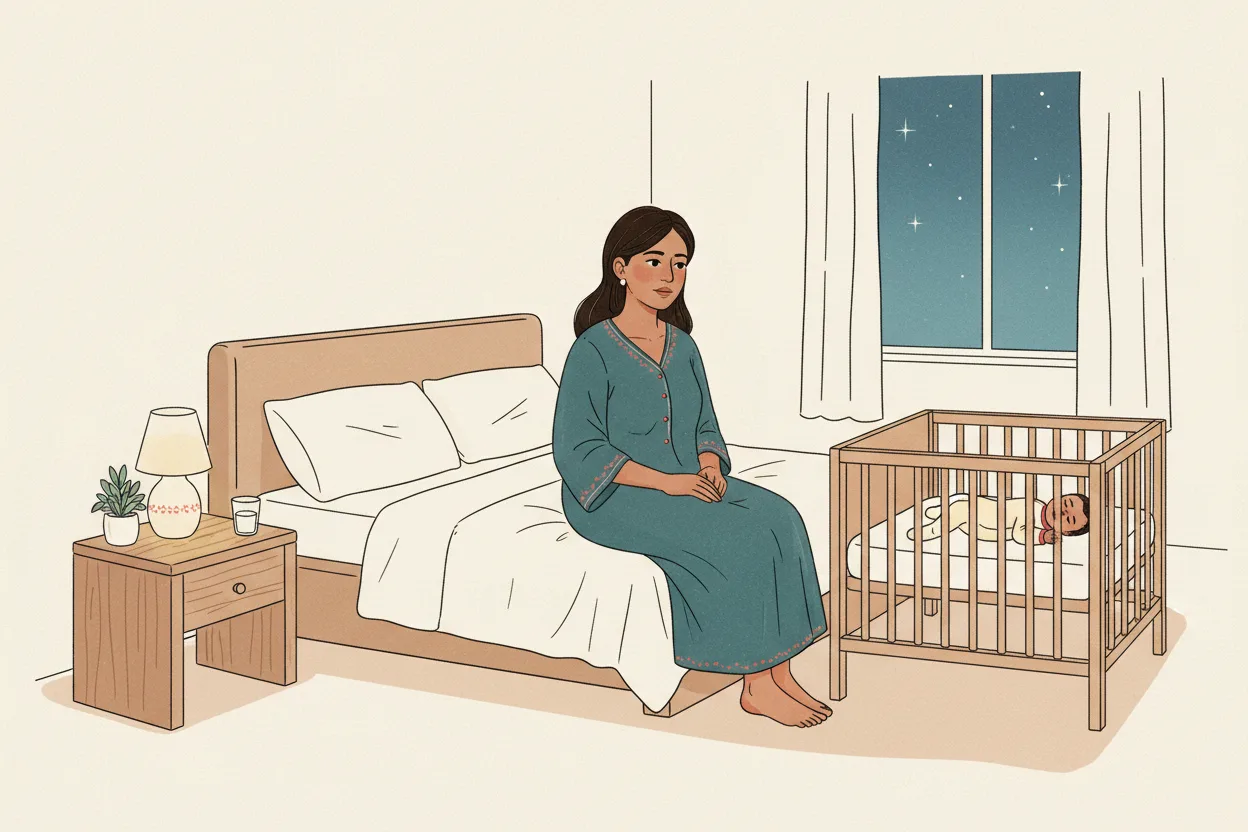

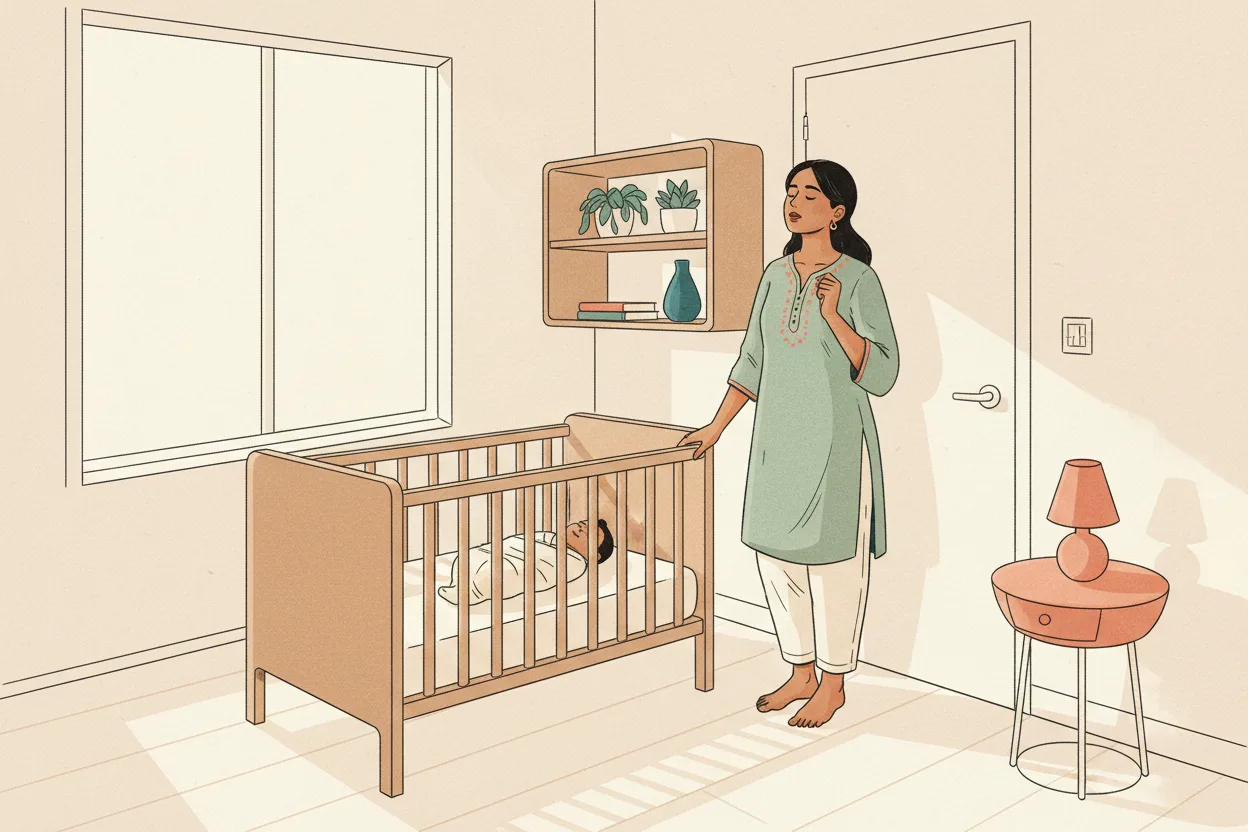
If you have just put your baby down harder than you meant to, or you can feel it building right now, the instruction that matters most is this: put her down and walk away. The NHS advises that when nobody can take your baby for a short time and the crying is making you stressed, you put her in her cot, make sure she is safe, close the door, go into another room and calm yourself down — with a time limit, ten minutes for example, then go back.
That is the official advice, not a confession of failure. The same NHS page says there may be times when you are so tired and angry you feel you cannot take any more, that this happens to a lot of parents, and that you should not be ashamed to ask for help. Saying it out loud is what makes it fixable; keeping it secret is what leaves you alone with it tomorrow night.
Not medical advice — talk to your paediatrician or doctor about you and your baby.
Do This First, In The Next Five Minutes
The American Academy of Pediatrics sets out the sequence for the moment you feel you are getting angry and might lose control: take a deep breath and count to ten, place your baby somewhere safe such as a cot or playpen with no blankets and no soft toys, leave the room, and let her cry alone for about ten to fifteen minutes.
In your flat, right now:
- Lay her on her back in the cot. Firm, flat, nothing loose in there with her.
- Walk out and shut the door. Balcony, kitchen, bathroom — anywhere the sound is muffled.
- Set a timer. Drink water, put music in one ear, wash the vessels, ring your sister.
- If you have not calmed down by then, the AAP says to check on her but not pick her up until you have, then go back and try soothing again.
A baby crying on her back in an empty cot is in the safest place in your house. The NHS's ICON campaign makes it one of four core messages — it is okay to walk away once you have checked the baby is safe and the crying is getting to you, and to go back and check on her after a few minutes when you are feeling calm; infant crying is normal, and it will stop. You, holding her while your hands are shaking, is the riskier arrangement — which is the whole reason the advice exists.
The One Line That Must Never Be Crossed
Said once, accurately, and then we move on. The AAP explains that babies cannot yet fully support their heavy heads, so violent, forceful shaking or impact injures the brain — this is abusive head trauma — and that it is never safe to shake, throw, hit, slam or jerk any child.
How fast it happens is the part most parents do not know. MedlinePlus, from the US National Library of Medicine, states that the injury can occur from as little as five seconds of shaking, that the brain bounces against the skull and can bruise, swell and bleed, and that most cases involve an angry parent or caregiver shaking a baby crying inconsolably — and that many times the caregiver did not intend to harm the baby.
That last clause cuts both ways. It is not an accusation against you; it is why the rule is absolute rather than a matter of judgement. Intention is not what protects a baby's brain. Distance is.
If It Has Already Happened
If your baby has been shaken or thrown, or handled roughly, she needs a doctor's eyes on her today rather than at the next scheduled visit. MedlinePlus lists the symptoms and says to contact your health care provider if a child has any of them, regardless of how mild or severe they seem.
| Watch for | What it looks like at home |
|---|---|
| Lethargy, sleepiness, decreased alertness | Hard to wake, floppy, not smiling, unusually still |
| Extreme irritability | Crying that will not settle at all, unlike her usual |
| Vomiting | Beyond ordinary posseting |
| Poor feeding, lack of appetite | Refusing feeds she would normally take |
| Breathing changes, pale or bluish skin | Any struggle to breathe, any colour change |
| Convulsions, loss of consciousness, loss of vision | Any fit, any blanking out |
Go to a paediatric emergency department and say what happened. Plainly. MedlinePlus's instruction is to make contact regardless of how mild the signs look, and a doctor cannot look for a head injury she has not been told about — imaging decisions turn on the history you give. If your baby was put down harder than you intended and is behaving completely like herself, she still deserves a mention at her next check, so a paediatrician can examine her and so somebody knows you are struggling.
Catching The Surge Earlier
The surge is not random. It builds through a bad feed, a missed nap, a third wake-up, a remark from a relative, and lands at the hundredth minute of crying. The useful move is upstream of the peak.
An Indian Academy of Pediatrics module on incessant crying tells clinicians to help parents recognise signs of tiredness, respond before the baby is too worked up, and — in the same list, for the mother — provide reassurance, empathy, support and time out for the parents. Your break is part of the clinical plan, not a treat you have to earn.
So name one person in advance: your husband, your mother, your mother-in-law, a neighbour, the nanny — one named person willing to take the baby for twenty minutes when you message two words. Settling that on a calm Sunday evening is far easier than negotiating it mid-howl. Then hand over at the first prickle rather than at the end of it, which looks like nothing happened, and that is exactly the point.
Sleep is the amplifier under all of it. A study of first-time mothers hosted by the NIH found that mothers who slept under four hours between midnight and 6 a.m., and mothers who napped under sixty minutes in the day, were at increased risk of depression at three months postpartum regardless of their baby's temperament. A 2022 study in BMC Pregnancy and Childbirth found that mothers rating their own sleep as poor were 2.9 times more likely to report intense anger. One protected sleep block is safety equipment; surviving nights with no help at hand covers how to carve one out.
When It Is More Than A Hard Day
Rage after birth is common, and not merely a side effect of something else. The same BMC Pregnancy and Childbirth survey found that 31% of 278 mothers reported intense anger, and that almost half of them did not screen positive for probable depression at all. Anger is worth raising with a doctor on its own terms.
It is also on the symptom list. The NHS lists feeling restless or irritable, feeling guilty or worthless or like a bad parent, and thoughts of harming yourself or your baby among the symptoms of postnatal depression — and says it is important to get help even if you only have some of the signs, because you are more likely to get better with treatment.
Then there are the thoughts that frighten parents into silence. A BMC Psychiatry study protocol hosted by the NIH reports that between 70 and 100% of new mothers have unwanted, intrusive thoughts of harm coming to their baby, as many as half of them thoughts of harming the baby on purpose, that preliminary evidence indicates these do not predict harming behaviour, and that they do not reflect the person's actual wishes or intentions. A thought that horrifies you is evidence of your values, not a forecast.
The World Health Organization states that about 13% of women who have just given birth experience a mental disorder, primarily depression, and that maternal mental disorders are treatable.
Getting Help In India, Without Becoming A Case
The fear underneath the silence is usually the same: if I tell someone, they will take my baby away. The NHS addresses it directly — you may be scared your baby will be taken away if you ask for help or share how you are feeling, but this is very rare, and your care team will give you the support you need to care for your baby.
There is a free route in, and you can use it tonight. India's Ministry of Health and Family Welfare set up Tele MANAS, a toll-free 24x7 national tele-mental-health helpline on 14416, where callers choose the language they want to speak. Alongside it: your obstetrician, your paediatrician at the baby's visit, your GP, a therapist. A meta-analysis of 38 Indian studies covering more than 20,000 women found a pooled postpartum depression prevalence of 22%, so this is nothing exotic to bring to a doctor. If clinics feel impossible with a small baby: online postpartum therapy and what to know about medication.
The silence has an Indian layer worth naming rather than swallowing. A 2026 study of urban Indian mothers in Frontiers in Global Women's Health notes that women here are socialised to suppress distress after birth, that voicing anger gets called selfish or socially disruptive, and that the "good mother" ideal of self-sacrifice keeps producing cycles of guilt and silence. If admitting you shouted at your baby feels unspeakable in your family, that is a cultural script talking, not a verdict on you.
The Problem Underneath Is Usually Solvable
After the put-her-down rule, this is the most useful thing here: what generates the rage is often a fixable feeding problem, and sorting it out takes the heat out of the whole day. A baby arching away from the breast, screaming when brought to feed and gaining slowly is not a mystery — it has names and it has fixes.
The AAP's guidance on breastfeeding problems is blunt about timing: problems can grow worse very quickly, it is vital to get help right away, and you should keep asking your paediatrician for one-on-one guidance until you actually get it — with inadequate weight gain among the strongest signs a baby is not getting enough milk.
- Sudden refusal of the breast is often a nursing strike rather than self-weaning, and usually temporary and coaxable: nursing strikes in breastfed babies.
- Slow weight gain at three to four months is sometimes the ordinary growth slowdown and sometimes a real problem, with a defined set of checks that separate the two: slow weight gain in a breastfed baby.
Book the lactation consultant and the paediatric weight check this week, not next month — because you are at the end of your rope, and that is a clinical reason in its own right. If the crying itself is the pattern rather than the feeding, colic and the witching hour covers where the line sits.
This Applies To Everyone In The House
Treating this as a mothers-only problem is how fathers and grandparents end up with no rule to follow. The AAP says that anyone caring for your children — parents, childcare providers, older siblings, grandparents, neighbours — should know about the dangers of shaking or striking a baby's head, and the NHS notes that fathers and partners can have depression after a baby too. So say it out loud at home, once, to everyone: if the baby will not stop and you feel yourself going, she goes in the cot and you walk out, and nobody gets judged for it. Agreed in advance, that sentence is worth more than any amount of resolve at midnight.
The Short Version
Put her down when it comes. Get her looked at today if she was handled roughly. Ring 14416, or your doctor, this week. Get the feeding assessed, because that is the fire under all of it. None of this is the behaviour of a bad mother — it is the behaviour of a mother doing the right thing a little late, which still counts.