No. It does not make you a bad mother.
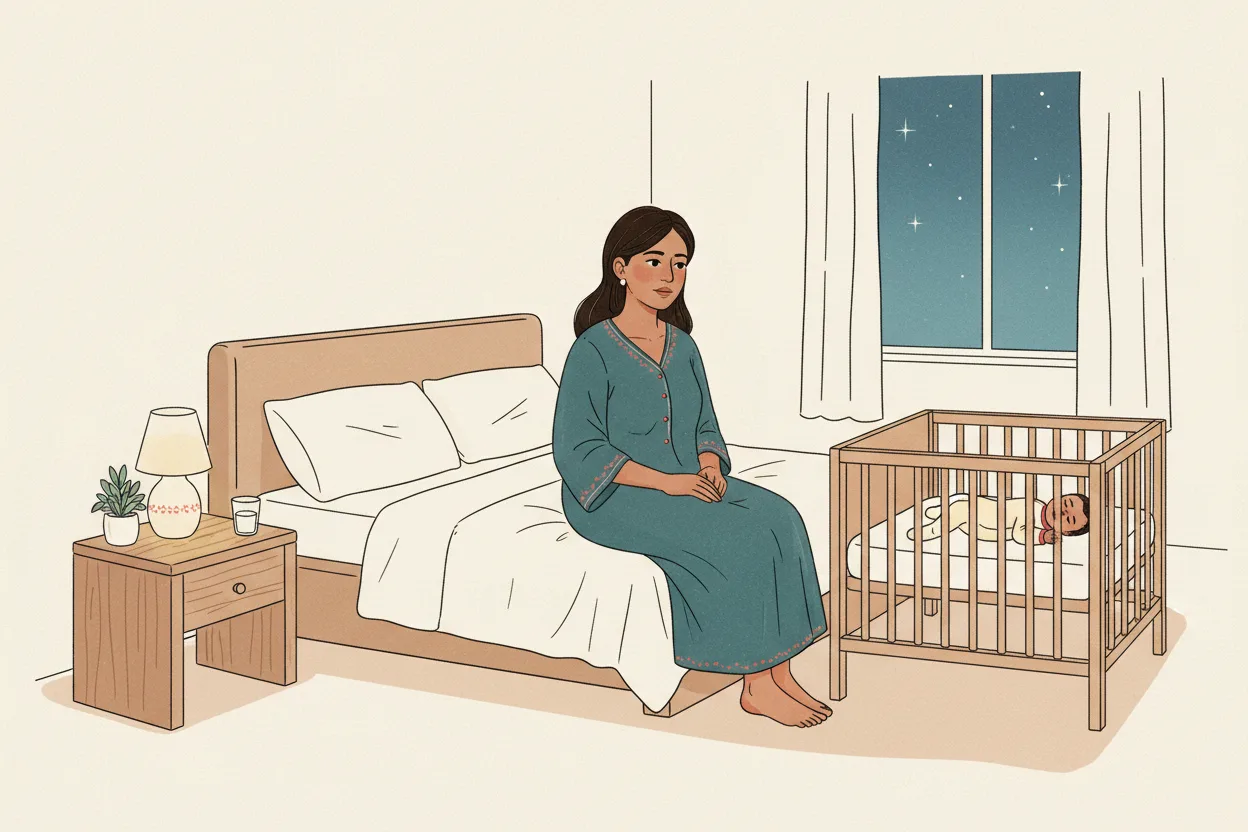
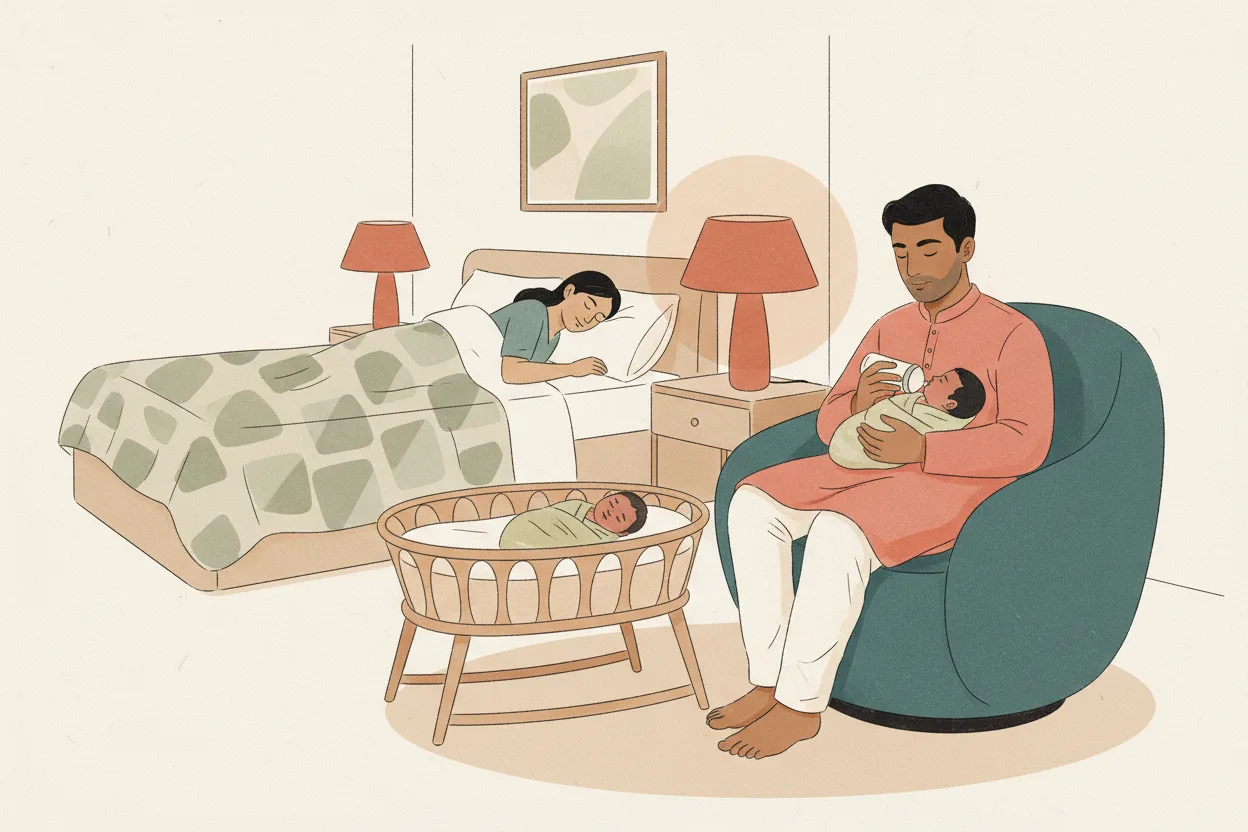
You stopped doing the night feeds because your body could not keep doing them. That is a limit, and working around a limit is what care plans are for. Your twins are being fed at 2am by an adult awake enough to do it properly. From where they lie, that is the whole story.
Not medical advice — talk to your obstetrician, your babies' paediatrician, or a mental health professional about anything specific to you.
Your Body Is the Constraint, Not Your Character
Your twins arrived at thirty-four weeks, a little under two months ago, after three IVF cycles and several uterine surgeries. That is not a rough patch. It is a long sequence of medical events, the last of them major, and you are still inside the recovery window for it.
It helps to see that the guidelines treat your recovery as care in its own right, not as an afterthought to the babies'. WHO's postnatal care guidance says that "dedicated postnatal services should provide vital physical and mental health support" — support for you, delivered to you, because the weeks after birth are a medical period for the mother and not only for the baby.
Sleep sits inside that. It is tempting to file sleep under comforts you can postpone, somewhere below the babies and above a hot lunch. The evidence does not file it there. A population-based study of postpartum women published in SLEEP found that "poor sleep was associated with depression independently of other risk factors" — not as a symptom of depression, but as its own separate risk sitting alongside the usual ones. A 2022 study of postpartum fatigue, sleep quality and resilience found that "mothers with higher levels of fatigue, poor sleep quality, and low resilience were at high risk of developing PPD."
Read in that light, handing over the night is not the opposite of looking after your babies. It is the thing that keeps their mother functioning, and it is ordinary advice: the AAP's guidance for new mothers says to "try sleeping when the baby is sleeping. Or ask your partner or another caring adult to watch your baby while you take a break."
If the pushback you are getting is that you have a maid and a nanny so you have nothing to complain about, that is a separate argument with a separate answer. This piece is about your own verdict on yourself, which is harsher than anyone else's.
What Actually Changes for the Twins
Very little, and this is the part the guilt keeps hiding from you.
Your babies need milk, warmth, clean nappies and someone who responds to them. At night, mostly, they need the bottle to arrive. The American Academy of Pediatrics states that "formula still gives your baby the nutrition they need to grow" — and nothing in that sentence depends on whose hands are holding the bottle. A feed given by your nanny or your husband at 3am is a feed.
Shared nights are not a workaround that paediatricians tolerate; they are what they tell families to do. The American Academy of Pediatrics advises partners to "take shifts with diaper changes, feedings (if bottle-feeding), and rocking and calming the newborn" — and the same page counts the sleep this buys as the point, noting that "even just a few extra hours in bed can help parents cope better with the stresses of new parenthood."
There is also a quieter finding worth holding on to. A study of mothers in urban Jharkhand found that "social support emerged as one of the strongest protective factors against PPD." Your nanny may be so-so and your mother-in-law may have stayed away, but the arrangement you have built — someone else on nights, so you sleep — is the protective thing, built by you, out of what was available.
What is in the bottle is a different question, and we have answered it separately: formula is a legitimate choice, not a consolation prize. If you are still working on supply, here is how to come off triple feeding, and if you later want to take a night shift back, the mechanics of splitting nights are here.
Why the Guilt Is This Loud
Guilt tends to scale with how much you wanted this, not with how well you are doing it — and the research bears that out. A thematic meta-synthesis of research on parents after medically assisted conception found that "mothers who conceived via MAC experience a need to provide idealised and 'perfect care'", along with "a reduced sense of entitlement to complain about the negative aspects of parenting." Three cycles and several surgeries bought you the babies and, as a side effect, a private rule that you are not allowed to find this hard.
Add twins. A Danish nationwide registry study of about 27,000 twin births found that "the 6 months adjusted cumulative RR of PPD in twins compared to singletons was 1.24 (95% CI 1.10-1.40) for mothers", with the gap widest around two months after birth — which is exactly where you are standing. The arithmetic of your life right now is harder than the arithmetic most advice assumes, and the preterm delivery sits underneath all of it; that part has its own recovery.
Rule Out the Boring Physical Causes
Before you accept "my health" as a vague fog, get it named. Fatigue after a twin delivery often has treatable causes sitting under it. A study of two Indian pregnancy cohorts found that "40% of postnatal women had low ferritin" — iron stores low enough to matter, in an ordinary hospital-booked population. And the NHS lists, among the symptoms of iron deficiency anaemia, "tiredness and lack of energy", adding that "it's treated with iron tablets and by eating iron-rich foods."
So at your next appointment, ask your obstetrician to check your haemoglobin and iron stores rather than assuming this is just what two months of twins feels like. A body that is being treated recovers faster than a body being blamed.
When the Guilt Has Become Something Else
There is a line between a hard fortnight and an illness, and "am I a bad mother" sits uncomfortably close to it. The NHS lists among the symptoms of postnatal depression "feeling guilty or worthless, or that you're a bad parent" — the exact thought, named as a symptom rather than a fact — alongside low mood, constant anxiety, difficulty sleeping even when you get the chance, and difficulty bonding with your baby. The same guidance adds that "it's important to get help even if you only have some of the signs."
In India the first stop is your obstetrician, who can screen you and refer you to a perinatal psychiatrist or therapist. If you want to talk to someone tonight, the government's Tele-MANAS service is free and round the clock: the Ministry of Health and Family Welfare announced at its launch that "a toll-free, 24/7 helpline number (14416) has been set up across the country allowing callers to select the language of choice".
You asked whether handing over the nights makes you a bad mother. What it makes you is a mother noticing a constraint and building around it, at two months postpartum, with twins, and without the family help you were entitled to expect. That is not the behaviour of a bad mother. It is a plan.