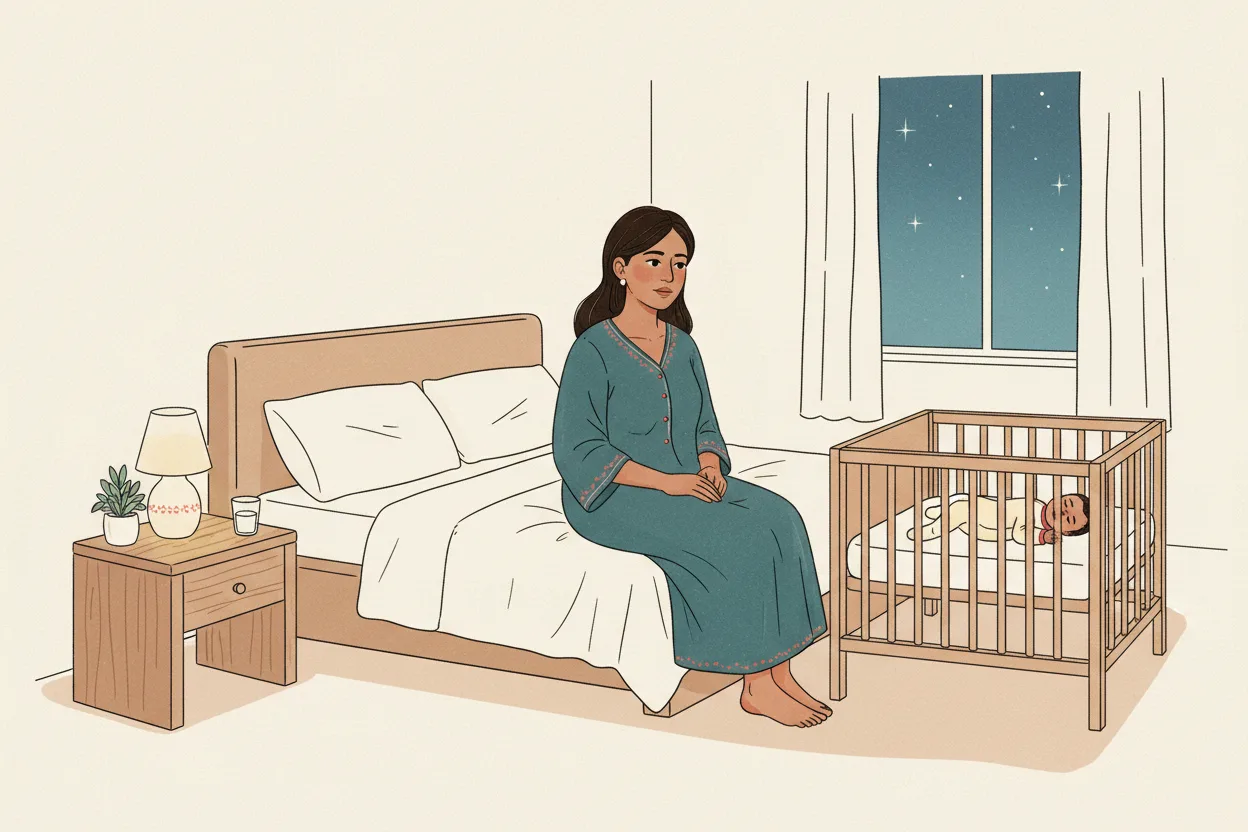
You are not exaggerating, and the number of hands in your house is not the measure of how tired you are allowed to be. Sleep chopped into pieces is its own injury, separate from how few hours it adds up to: a randomised experimental study in the journal Sleep found that "despite comparable reductions in total sleep time, partial sleep loss from sleep continuity disruption is more detrimental to positive mood than partial sleep loss from delaying bedtime" — and that the interrupted nights cut into slow-wave sleep, the deep stage the brain actually repairs itself in.
And the totals can look almost respectable while the night itself is in ruins. A study that tracked first-time mothers' sleep with wrist actigraphy across the first four postpartum months found that although nocturnal sleep averaged about 7.2 hours, "this sleep was highly fragmented (similar to fragmenting sleep disorders) and inefficient" — the authors compared the daytime effects to those of fragmenting sleep disorders such as sleep apnoea.
Not medical advice — talk to your obstetrician, your baby's paediatrician, or a mental health professional about anything specific to you.
Two Things That Are Both True
Your mother-in-law is not imagining her own contribution. She cooks. She runs the laundry. She steams and mashes and stores the baby's food. She takes the baby at five-thirty so you can have your one solid stretch, and there is a maid for the floors. By any fair accounting, your household carries you more than most households carry anyone.
You are also wrecked. Both of these are true at the same time, and the moment anyone in the house decides that only one of them can be the real story, the conversation stops working. Nobody here has behaved badly. The support your family gives is real, generous and daily — it is simply aimed at a shortage that is not the one you have.
Why the Arithmetic Does Not Work
The obvious defence sounds unanswerable: eleven to five in pieces, plus a solid stretch from five-thirty to seven, is near enough eight hours, and plenty of people function on less. That treats sleep as a quantity in a bucket, and sleep does not behave like one. A population-based study of 2,830 women seven weeks after birth reported that "the duration of sleep and sleep efficiency were not associated with depression, whereas poorer subjective reports of sleep quality and sleep disturbances were" — the hours were not the part that tracked how the mothers were actually doing.
Fragmentation alone is enough to do it, with no baby and no postpartum body involved. An experimental study woke eleven childless women three times in a single night and found that their mood and their own rating of their sleep "both decreased significantly after sleep fragmentation compared to baseline measurements". Three interruptions. One night. Healthy women with nothing else going on.
This is also why the dawn handover, which is genuinely generous, cannot settle the account. A study that followed first-time mothers through their first twelve weeks found that "despite improvements in postpartum sleep, neurobehavioral performance continued to worsen", and the authors attributed that to the cumulative effects of sleep disturbance. Our reading of that: one recovered block at the end of a night in six pieces is a patch, not a repair. It is why you can sleep until seven and still feel scraped hollow by ten.
If you want one line to hand to someone doubting you, it is this: the clock is not measuring the thing that is hurting you.
Help With Chores Is Not Help With Sleep
Here is the distinction that resolves most arguments in houses like yours, and we will own it as our reading rather than dress it up as a finding.
The work your mother-in-law has taken over is real work, and somebody has to do it. It buys back your daytime — your hands, your afternoons, your capacity to be decent company at dinner. What no amount of it buys is one unbroken block of sleep. Cooking cannot. Laundry cannot. Mashing the sweet potato cannot. A maid cannot. Even the five-thirty shift cannot, because by five-thirty the damage to the night is already done.
| What the household covers | What it genuinely gives you | Does it give you unbroken sleep? |
|---|---|---|
| Cooking, every meal | Your daytime hours, and food you did not have to plan | No |
| Laundry and cleaning | Fewer tasks, less mental load | No |
| Preparing the baby's solids | A real daily chore removed | No |
| The five-thirty-to-seven shift | One recovery stretch, at the end of the night | Partly — one block, after the night is already broken |
| Someone else being the one the baby wakes, for a fixed block, with your door shut | Consolidated sleep | Yes — this is the only one that does |
The shortage in your house is not chores. It is consolidated sleep, and consolidated sleep is the one thing nobody has actually been asked to supply.
Asking For the Specific Thing
"I need more help" is the wrong ask, and in your house it also sounds like an accusation — because more help is exactly what she has already given. The ask is narrower and stranger-sounding: a protected, predictable block of sleep, with somebody else fully responsible for the baby, and your bedroom door shut. Protected means the block is agreed in advance. Predictable means you know which nights. Responsible means they handle the waking, rather than fetching you for it.
Three sentences you could actually say. To your mother-in-law:
"Mummy, you already do more than anyone I know, and I am not asking for more work. There is one specific thing that would change everything for me: twice a week, could you keep her in your room from eleven to three, and come for me only if she is really inconsolable? I will shut my door and sleep through it."
To your partner, which is the harder conversation if you are feeding at night:
"I need one four-hour block where I am not the person she comes to. Can we try this on Friday and Saturday: I feed at ten, you take the room till two with a bottle of what I pumped, and you wake me only if she refuses it? Let us try three nights before we decide it cannot work."
And for the moment someone tells you that you have it easy:
"I know I do. I am lucky, and I am also running on sleep broken into six pieces every night, and those are two different things."
Mainstream advice backs the partner version of this arrangement. The NHS advice on coping with disturbed nights says that "once you're into a good breastfeeding routine, your partner could occasionally give a bottle of expressed breast milk during the night", and suggests asking a partner to take over the early-morning changing and dressing so that you can go back to sleep. The mechanics of that handover — pumping, timing, how much to leave out — are their own project, and we have written them up in splitting night feeds with pumped milk.
When You Hear That They Managed With Five Children
You will hear it, and it is worth hearing properly instead of arguing with. Two gentle things to hold on to, both of them judgement rather than evidence.
First, a recollection of one's own postpartum is not data. It is a story told decades later, from the far side, by a person remembering the headline and not the 2am. Nobody is lying. Memory simply does not keep the texture of a year of broken nights.
Second, what was endured is not the same as what was fine. "We managed" describes an outcome, not an experience. Plenty of women in her generation were exhausted exactly as you are and had no language for it, no word like fragmentation, nobody suggesting their tiredness was worth naming. Getting through it without complaint is not proof that it was bearable, and it is not a standard you owe anyone.
She may also be hearing your exhaustion as a verdict on her help, which would sting anyone doing that much. Saying the quiet part out loud — that what you need is sleep rather than more chores, and that she has already covered the chores — tends to land better than defending how tired you are. If what is really on your mind is live-in family support and what it costs, the trade-offs of village support with in-laws covers that separately.
When It Is More Than Exhaustion
There is a point where this stops being a sleep problem. The NHS lists the symptoms of postnatal depression — low mood, finding it hard to enjoy anything, feeling hopeless or that you cannot cope, feeling guilty or worthless, anxiety or worrying all the time, feeling restless or irritable, trouble concentrating, difficult feelings about bonding with your baby, thoughts of harming yourself — and notes "difficulty sleeping, even when you get time to rest" among them, adding that "it's important to get help even if you only have some of the signs. You're more likely to get better with treatment." That sleep symptom is the most useful line in your situation: being wrecked because a baby wakes you is exhaustion, while lying awake inside a protected block you fought for is a different signal altogether.
This is common, and it responds to treatment. A systematic review and meta-analysis of 38 Indian studies, published in the Bulletin of the World Health Organization, found that the "pooled estimate of the prevalence of postpartum depression in Indian mothers was 22% (95% CI: 19-25)" — roughly one mother in five. WHO states that about 13% of women who have just given birth experience a mental disorder, primarily depression, and that "maternal mental disorders are treatable. Effective interventions can be delivered even by well-trained non-specialist health providers."
The route to help in India is ordinary and does not require a crisis. Your obstetrician or your baby's paediatrician can point you to a perinatal mental health service, and the Ministry of Health and Family Welfare states that under the National Tele Mental Health Programme "a toll-free number (14416) has been set up across the country", offering free round-the-clock tele-counselling in a range of languages. You can use it from your own room without explaining yourself to anybody in the house.
If the tiredness has started coming out as anger at the baby, that has its own practical handling, and we have written it up in losing your temper with your baby.
The Night Waking Is Still Worth Solving
Being believed is not the same as being stuck. The AAP notes that "it is normal for a 6-month-old to wake up during the night and then go back to sleep after a few minutes" — so some waking is ordinary, but the every-ninety-minutes, only-settles-at-the-breast version is a recognised pattern with recognised handles, and it is worth working on in its own right rather than only enduring. Those handles live in their own pieces: the four-month sleep regression, breaking the nurse-to-sleep association, and the sleep regression that comes with crawling.
Most exhaustion writing assumes the opposite house. If yours is the mirror image — a high-contact baby and no live-in help at all — then touched-out and exhausted in a nuclear family and carrying both the day and the night shift alone are the pieces for that. This one is for the house where the help is real and the sleep still is not.
Frequently Asked Questions
Am I overreacting about being tired when I have this much help? No. The amount of help in your house and the state of your nights are separate facts. A randomised study in Sleep found that losing sleep through repeated interruptions was "more detrimental to positive mood than partial sleep loss from delaying bedtime" despite comparable reductions in total sleep time — so the shape of your night matters, not only its length.
If my hours add up to seven or eight, why am I this shattered? Because the hours are not the variable that tracks how you feel. A study of 2,830 postpartum women found that "the duration of sleep and sleep efficiency were not associated with depression, whereas poorer subjective reports of sleep quality and sleep disturbances were".
Does the early-morning stretch my mother-in-law gives me not make up for the night? It helps, and it is worth having, but it is a patch rather than a repair. Research following mothers across twelve postpartum weeks found that "despite improvements in postpartum sleep, neurobehavioral performance continued to worsen", which the authors linked to the cumulative effects of sleep disturbance.
What exactly do I ask for, if not more help? One protected, predictable block of consolidated sleep, with another adult fully responsible for the baby and your door shut. Name the nights, name the hours, and name the only condition on which you want to be woken. Chores and sleep are different currencies, and your house has been generously paying in the wrong one.
Is it normal for a six-month-old to be waking this often? Some night waking at this age is ordinary — the AAP notes that "it is normal for a 6-month-old to wake up during the night and then go back to sleep after a few minutes". Waking every ninety minutes and settling only at the breast is a recognised pattern worth addressing on its own terms, which is what our sleep-regression and nurse-to-sleep pieces are for.
How do I tell exhaustion from postpartum depression? The NHS lists low mood, hopelessness, guilt, constant anxiety, irritability and "difficulty sleeping, even when you get time to rest" among the symptoms of postnatal depression, and says "it's important to get help even if you only have some of the signs. You're more likely to get better with treatment." Being unable to use sleep when you finally get it is the signal to take seriously.
Where do I get help in India without making it a family event? The Ministry of Health and Family Welfare states that under the National Tele Mental Health Programme "a toll-free number (14416) has been set up across the country" for free, round-the-clock tele-mental-health counselling, and WHO states that "maternal mental disorders are treatable. Effective interventions can be delivered even by well-trained non-specialist health providers."