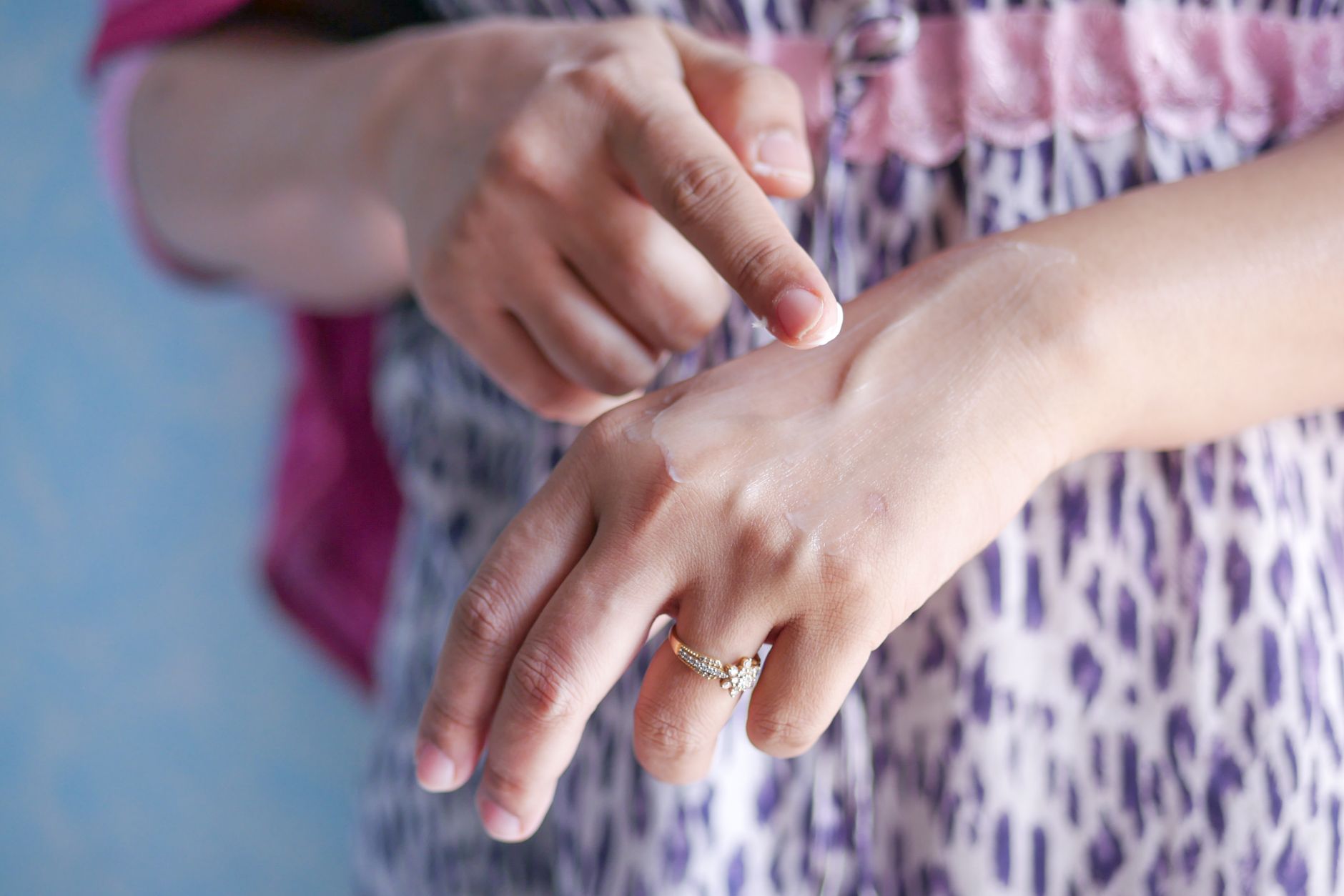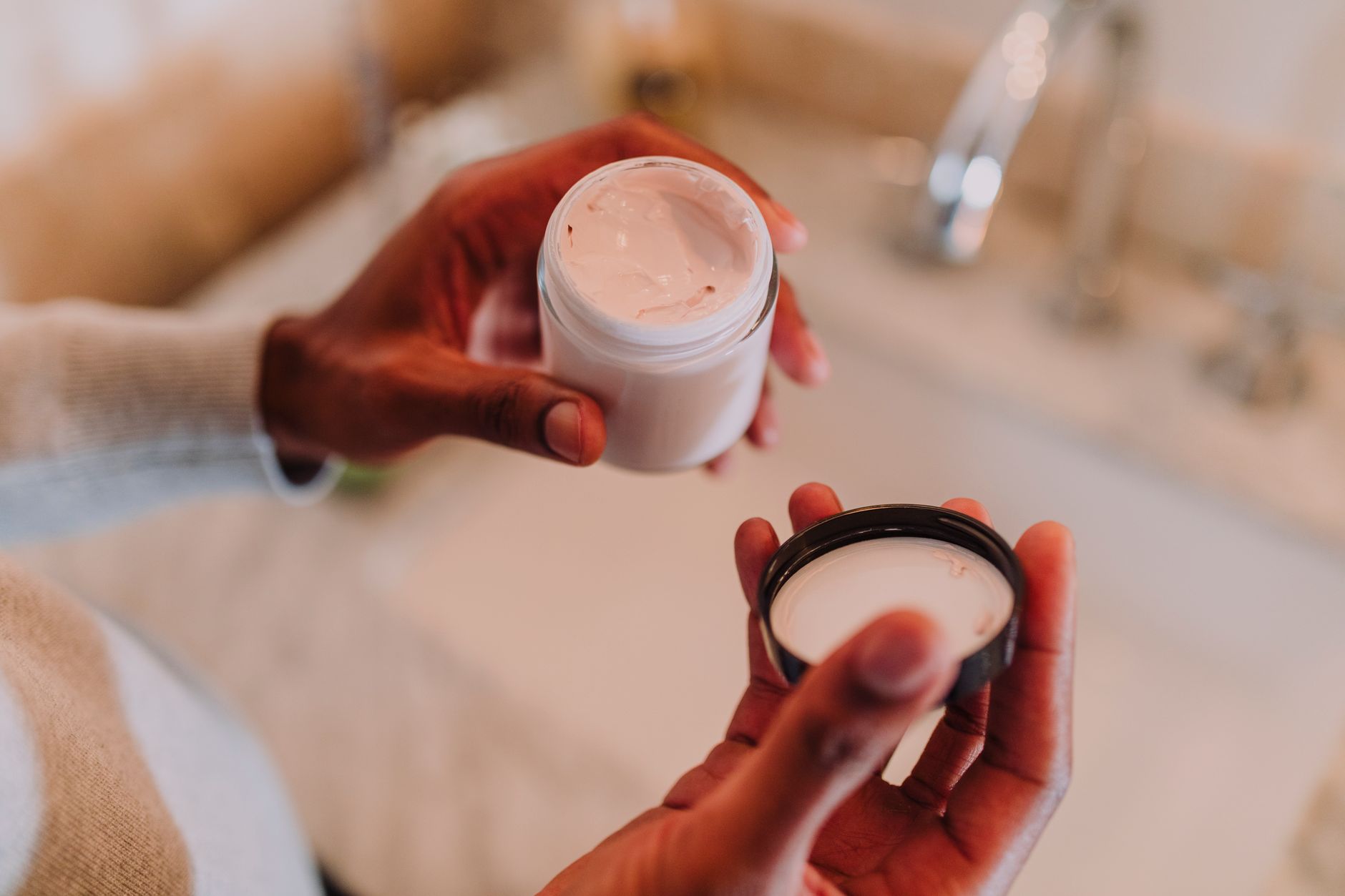
A face cream is not a tablet. That one distinction collapses most of the rabbit hole. The NHS Specialist Pharmacy Service states that topical and inhaled routes give lower levels in breast milk than systemic routes of administration — so the eye cream on your shelf is a genuinely different question from a medicine you swallow.
Not medical advice — talk to your dermatologist, pharmacist or doctor about your own skin and your own baby.
That is not the same as "everything is fine". There is a short list worth a second thought, one rule about where you apply things, and — more useful than any list — a way to check a product yourself.
Why a cream is a different question from a tablet
A tablet lands in your bloodstream almost entirely. A cream has to cross skin first, and most of it never does. The clearest evidence we have is for topical steroids, the one class of cream that has been studied properly in nursing mothers: the NHS Specialist Pharmacy Service's lactation guidance says that inhaled or topical corticosteroids give very small or negligible systemic concentrations in the mother, leading to negligible concentrations in breast milk, and therefore pose no significant risk to the breastfed infant.
Two things move the dial. How much skin you cover, and whether you cover it over. A systematic review of cosmetic procedures in pregnancy and lactation in the International Journal of Women's Dermatology notes that salicylic acid can have significant dermal penetration of up to 25% if large areas are treated or when it is applied under occlusion. A pea of eye cream on two fingertips sits at the opposite end of that scale from a full-body treatment under cling film.
This is also worth having ready for the conversation at home, where "no chemicals while feeding" often arrives as settled fact from your mother-in-law or a visiting aunt. Giving up nursing so you can use a moisturiser is the worse trade: the NHS Specialist Pharmacy Service cautions that advising to stop breastfeeding is not a no-risk option, because it denies the infant and mother the benefits of breastfeeding.
The short list that genuinely warrants a second thought
Retinoids
This is the one everybody asks about, and the honest answer is more boring than the internet suggests. A review of dermatology medicines in the FDA's pregnancy and lactation labelling, published in the International Journal of Women's Dermatology, records that for topical tretinoin only minimal amounts are found in breast milk and these are not thought to be harmful to infants, while for adapalene excretion into breast milk is unknown and caution is advised. Over-the-counter retinol and retinaldehyde are weaker cousins of the same molecule.
So: thin data, low measured transfer, no documented harm. Many dermatologists still park retinoids until after weaning simply because there is little to go on — a reasonable preference, not a danger. The tablet is a separate matter. The NHS medicines guide to isotretinoin capsules says you must not take isotretinoin when breastfeeding because it can cause your baby to have side effects, and that your doctor will offer a different treatment instead.
Hydroquinone
The skin-lightening agent most often reached for after melasma, and the one worth a dermatologist rather than a shelf. The same labelling review records that for topical hydroquinone, excretion into breast milk is unknown. Read that as written: the data are missing, not bad. It is a fair thing to raise with your dermatologist and a fair thing to postpone — it is not evidence of harm, and nobody can tell you it is.
Salicylic acid
The same area-and-occlusion logic applies: a dab of a 2% leave-on product on a few spots is not the same exposure as a peel across your whole face and back. If a clinic is proposing a professional-strength peel while you are nursing, that is worth a direct conversation; a small amount from a bottle on your shelf is a much smaller question.
Two rules about placement, not ingredients
- Nothing on the breast or nipple is covered by "my face cream is fine." That skin feeds your baby directly. The NHS medicines guide to hydrocortisone skin cream advises that if you are using the cream on your chest, particularly on your breasts and nipples, you wash it off with warm water before feeding your baby.
- Keep products off the places your baby's mouth lands — chest, hands, inner forearms where a drowsy head rests. The NHS Specialist Pharmacy Service's guidance on topical steroids says precautions should be taken to avoid direct contact of the breastfeeding infant with treated areas, such as washing hands thoroughly after application and before touching the infant.
How to check any product yourself
A list of ingredients dates. A method does not.
1. Read the label in order. India's Central Drugs Standard Control Organisation guidance on cosmetics labelling requires that ingredients present above one percent appear in descending order of weight, followed by everything at or below one percent in any order. So the first five or six names are most of what is in the jar; a scary-sounding name at the very end is usually a preservative or fragrance component present in a trace. Packs at or under 60 ml of liquid or 30 g of solid are exempt from carrying the list at all, which is why some sachets and minis show nothing — look up the full-size version instead.
2. Look up the one or two names you care about, not all thirty. You are checking the actives: the retinoid, the acid, the lightening agent, the prescription steroid. Everything else in an eye cream — glycerin, squalane, niacinamide, hyaluronic acid, a thickener, a preservative — is a moisturiser.
3. Use a database that is written for this question. The NHS Specialist Pharmacy Service's list of recommended breastfeeding resources points to the NHS Medicines A–Z, where each medicine page carries a section on breastfeeding in patient-friendly language written by the UK Drugs in Lactation Advisory Service. Search nhs.uk/medicines plus the ingredient name. It is the quickest route for anything that is also a medicine — hydrocortisone, salicylic acid, isotretinoin. The same page names LactMed, the US National Library of Medicine's lactation database, as reputable and up to date though not covering every medicine; it is the deeper reference if you want the underlying evidence, and your pharmacist can pull it up for you.
4. Ask a person for the rest. Purely cosmetic ingredients are often in no lactation database at all, and absence of an entry is not a verdict. A pharmacist is the fastest free expert in the country for this, and the NHS medicines guide says to check with a pharmacist or doctor before using a cream on your skin while breastfeeding. Carry the product, or a photo of the ingredients panel, to your next dermatologist or paediatrician visit.
One thing to leave alone
If a dermatologist prescribed something knowing you are nursing, do not quietly stop it after reading a list online. Stopping treatment, or stopping feeding, is not the automatically safer choice — call the person who prescribed it and ask.
For the related questions we have covered separately: postpartum acne, hair fall and dry skin after delivery, and hair colour during pregnancy.