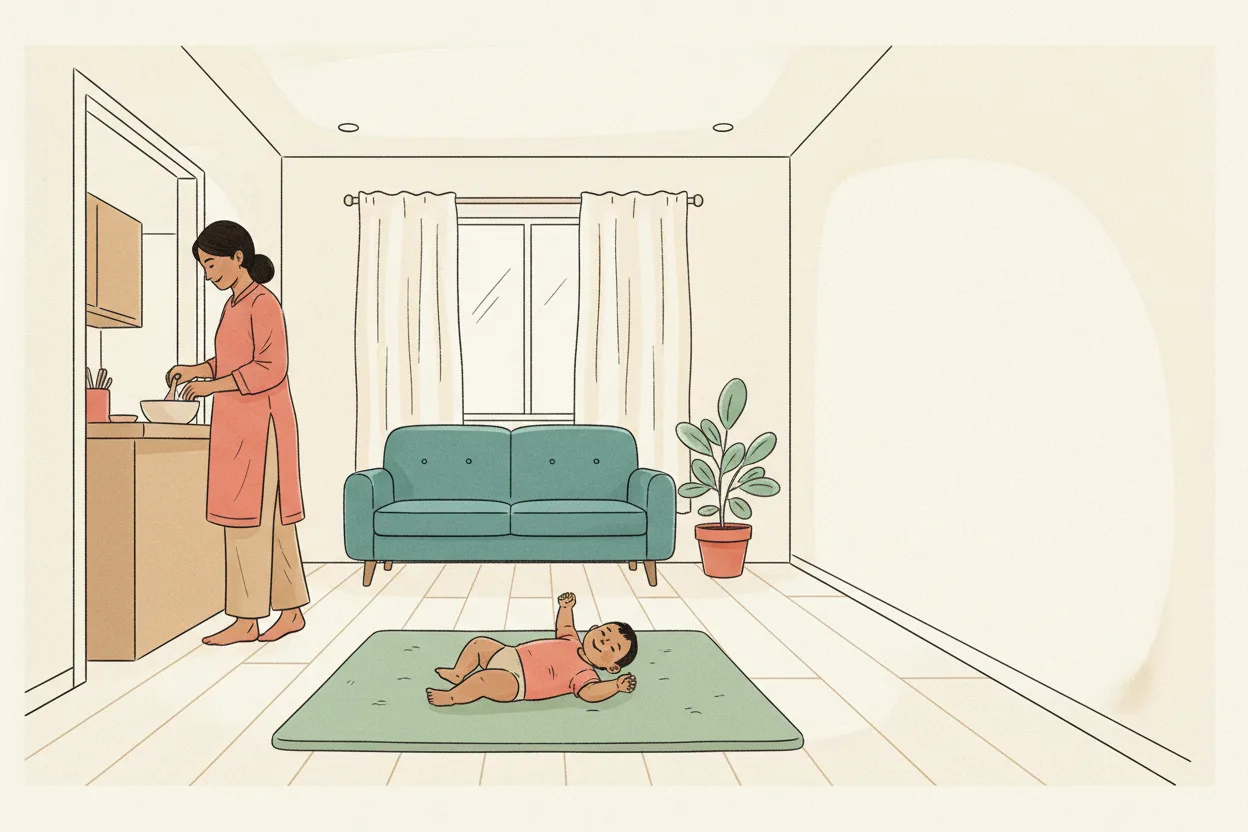
A clear patch of floor with a firm mat on it will carry more of your day than anything you can buy. It is the one surface in the flat she cannot fall off — and when you are the only adult at home, that single fact reorganises the whole shopping list.
The second surface is a cot. The NHS advises placing your baby in a separate cot or Moses basket in the same room as you for every sleep for at least the first six months, on a firm, flat mattress, on her back. Floor for awake time, cot for sleep. Between those two you have the two minutes it takes to shower, stir a pan, or open the door.
Not medical advice — consult your pediatrician.
The question hiding under the shopping list
In your hometown there were four pairs of hands, and someone could simply hold the baby while you ate or bathed. In the new flat there are two, and through the working day one. So the real question is not "baby cam, bouncer or bed rails" — it is where does she go when nobody can hold her? Answer that and the list gets short, specific and cheaper.
Why the floor beats every product in the shop
A baby on the floor has no height to fall from, which matters most at exactly her age. The AAP's movement milestones for four to seven months note that by the end of this period babies will probably be able to roll in both directions, with the time frame varying between babies — so you get no notice of the day she manages it. AAP guidance states you must never leave a child unattended on a dressing table, even for a moment, even if he is strapped, because falls from such a high surface can be serious. The hazard is the height, not the furniture — so your bed, the sofa, the dining table and the bathroom slab all inherit the rule. Good furniture is simply the wrong place to leave a baby alone.
The mat matters more than the brand. The AAP says a baby should sleep on a firm, flat, non-inclined surface without soft toys, pillows, blankets or other bedding — so if she drifts off down there, firm foam rather than a folded quilt, and the space around her bare. The AAP also advises that tummy time is for babies who are awake and being closely supervised, and that you limit time in freestanding swings, bouncy chairs and car seats. "On the floor" means in your line of sight from the kitchen or doorway, not in a shut room.
Floor level is a different hazard map from adult eye level. The AAP's checklist for a safe baby's room says to keep the space free of all small objects she could swallow, not to let strings or cords dangle near her, and notes that the CPSC recommends cordless window coverings where possible. In a new flat: chargers, the fan cable, looped blind cords, coins under the sofa — cleared before she goes down, not after.
The two-minute problems, one at a time
| What you need to do | Where she goes |
|---|---|
| Shower | Floor mat or cot, outside the bathroom, door open |
| Cook | Floor mat or play yard just outside the kitchen doorway |
| Answer the door or intercom | Cot or play yard |
| Step to the balcony, hang washing | Cot or play yard |
| Use the toilet | Floor mat right outside the open door |
Boring on purpose: two safe places, and you move her rather than gamble on a few seconds. In a 2BHK with bedroom, hall and kitchen off one corridor, a single mat in the hall covers most of the day.
The bath is the exception, and it is absolute
Everything above has a "for two minutes" clause. The bath has none. The AAP warns never to leave your baby alone or in the care of another young child in or near water — not even for a moment — and notes that babies can drown in as little as one or two inches of water, less than what stands in a bucket. Bath seats and supports are not the safety devices they look like: the CPSC found that in more than 90 percent of the bathtub-seat drowning deaths it reviewed the children had been left unattended, and said plainly that caregivers should know these are not a safety device.
So carry everything in first — towel, nappy, clothes, oil, mug. If the doorbell goes, she comes out wrapped and travels with you, including the time you are certain it will take four seconds. Your own shower is the reverse: she is not in the bathroom at all.
Her three named buys, answered honestly
The baby cam. A camera tells you something has happened; it does not stop it happening. The AAP's safe-sleep guidance says not to use home cardiorespiratory monitors as a way to reduce the risk of SIDS, that there is no evidence these devices decrease SIDS risk, and not to let them give you a false sense of security. Buy one for the job it does do — the balcony, the kitchen, a shower while she naps — not as permission. Placement and privacy: nanny cams and baby monitoring.
The bouncer. Useful for short, awake, harnessed stretches when you need both hands and she needs your face; no use as a bed. The inclined-seat sleep rule is covered in baby bouncers and rockers.
The bed rails. Not for her, not yet. The CPSC's federal standard for portable bed rails states that warnings must explicitly say rails should never be used with children younger than two years old, that they are intended for children age two to five who can get out of an adult bed without help, and that gaps in and around bed rails have entrapped young children and killed infants. A rail is for a toddler climbing out of a big bed, not a fence for a baby learning to roll — our bed rail guide covers when it earns a place.
The bulky buys: load-bearing or optional
| Purchase | Verdict | What it buys you |
|---|---|---|
| Cot with a firm flat mattress | Load-bearing | The one place she can be put down asleep |
| A floor-level enclosure — play yard or playpen | Load-bearing | Hands free for the kitchen, door, balcony |
| One firm, thick floor mat | Load-bearing, cheapest here | Awake time anywhere, in your sight |
| Baby bathtub | Optional, short-lived | Easier on your back; outgrown in months |
| Bedside shelf or co-sleeper | Optional | Night-feed convenience, not safety |
| Portable bed rail | Not yet | Nothing, at this age |
The standard applies to cheap folding enclosures too. The AAP's playpen safety guidance says never to leave the side of a mesh playpen lowered, to check the mesh is free of tears, holes or loose threads, and to keep mesh openings under a quarter of an inch across. Mesh versus wooden versus foldable — and whether baby-proofing one room beats buying one at all — is worked through in our playpen buying guide. The current field: play yards on Amazon India or FirstCry.
The bathtub is a back-and-knees purchase, not a safety one: bathing a wriggling four-month-old bent over a bucket is hard on a recovering body, and a tub on a stand fixes that — then is outgrown. Buy it if your back is asking. The bedside shelf is the same category: pleasant, not structural.
On nappies: there is no age at which a baby has to come off cloth. It is a laundry decision, not a developmental one, and plenty of families run cloth at home with disposables for outings and nights. See full-time diapering and best cloth diapers in India.
The half of this that nobody puts on a list
Being alone all day with a four-month-old in a city where you know nobody is hard in a way gear cannot fix, and worth planning for as deliberately as the cot. The WHO reports that about 13% of women who have just given birth experience a mental disorder, primarily depression, and that maternal mental disorders are treatable. Two things before the boxes arrive: save a paediatrician's number, and find one group of parents with babies the same age. More in newborn nights with no help and finding your village.
Common questions
Can I just put her in the middle of the bed with pillows around her?
No. AAP guidance states never to leave a child unattended on a dressing table even for a moment and even if strapped, because falls from such a high surface can be serious — and a bed is a high surface. Pillow barricades also add soft bedding to the picture. If it has already happened: a baby falling off the bed.
Does a baby monitor make it safe to leave her in another room?
It makes it observable, which is not the same thing. The AAP's safe-sleep guidance says not to use home cardiorespiratory monitors to reduce the risk of SIDS and not to let such devices give you a false sense of security. The room has to be safe on its own; the camera only saves you the walk.
She rolled over for the first time today. What changes?
The bed, the sofa and the changing surface stop being options even for a few seconds. The AAP's milestones for four to seven months note that babies will probably roll in both directions by the end of this period, with the time frame varying between babies. Most parents find out it has started by watching it happen somewhere they would rather it had not.