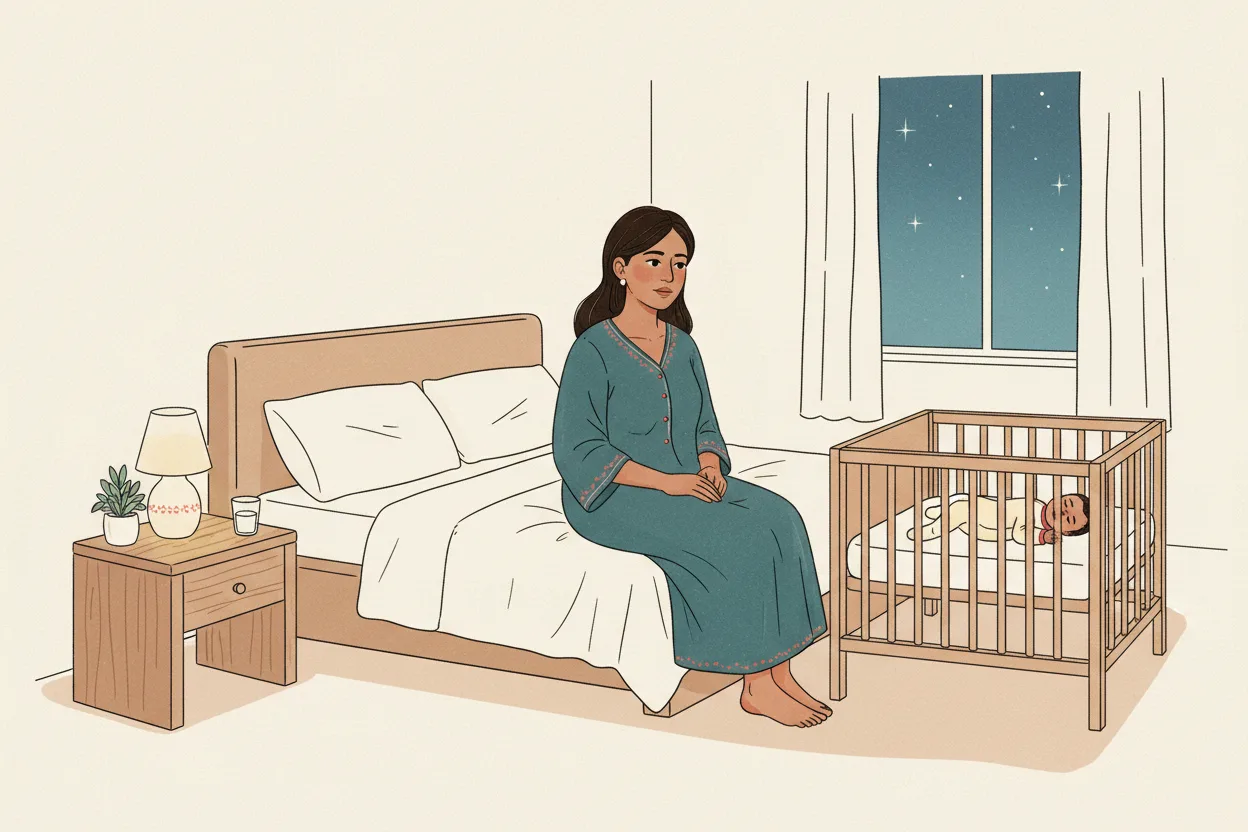

He is finally down. You sit, you pick up your phone, and forty minutes later he is awake and the laundry is where it was. You feel bad about it, and you wonder whether everyone else is folding clothes in that window while you read strangers argue about something you will have forgotten by evening.
You are not failing at something simple. The nap window is a genuinely hard problem, badly posed, and "why can't I just put the laundry on" has an answer that is not laziness.
Not medical advice — this is an ordinary daily decision, not a condition.
Why the window is the hardest decision of your day
The window has three awkward properties, all outside your control. You cannot see its edges — it might be forty minutes, it might be ten, and nothing tells you which until it ends. It arrives at the end of a long stretch of caregiving, not the start of a fresh day. And it is the only unsupervised time you are going to get, so every possible use of it competes with every other.
That middle point is not a feeling; it is measurable. A 2014 PLOS ONE diary study of thirty-three first-time mothers found that over half of them still scored as excessively sleepy at eighteen weeks postpartum. This is not every mother: a 2017 study in Sleep Disorders reported that its carefully selected low-risk first-time mothers "experienced minimal insomnia, nonrefreshing sleep, anxiety, depression, daytime sleepiness, or fatigue" despite frequent night waking. Tiredness varies enormously. But if you are running on empty by two in the afternoon, you are in documented company — and if the nights are the bigger problem, that is its own piece.
Does being that tired change how you decide? Partly, and less dramatically than the internet implies. A 2025 scoping review of sleep-deprivation research found that sleep loss impairs decision-making, but that "the severity of impairment varied based on the type of decision-making task" — and that a few of the studies it covered reported no significant effect at all.
The tidier explanation — that willpower is a tank that empties over the day — is on shakier ground than its popularity suggests. A 2014 reanalysis in Frontiers in Psychology found "very strong signals of publication bias" in that literature, "along with an indication that the depletion effect is actually no different from zero". We cite it because the pop-psychology version gets used to explain moments like this one, and it may not be true.
Our read, labelled as judgement: the problem is not that your self-control ran out. It is that the window asks you to plan — rest or chores, and which chore — at the one moment in the day when planning is most expensive, and then ends at a time you cannot predict. If the trouble is that there is no window at all, that is a different question: making time exist in the first place.
Does half an hour on your phone actually restore you?
The honest answer is that nobody has measured it. We could find no study asking whether twenty minutes of scrolling restores a mother of a napping baby — not in India, not anywhere. The wellness internet has a confident answer. The research does not.
What exists is research on passive social media use — scrolling and reading rather than posting — and it is messier than the headlines. A 2023 paper in Frontiers in Psychology notes that "the connection between passive social media use and mental ill-being is inconsistent", and that an earlier scoping review found the harmful effect supported by only a minority of studies. A separate 2023 study reported that "passive social media use was unrelated to these outcomes" — those outcomes being depression, anxiety and stress.
Judgement, clearly labelled: that is not a licence and it is not a warning. It means the confident claim that your phone is stealing your recovery has not been shown for your situation. Use your own evidence instead: notice how you feel when the window closes. Some days scrolling leaves you steadier, some days thinner. Both are real, and neither is a verdict on you.
What is well established is duller, and it is about sleep rather than leisure. CDC's sleep guidance states that "good sleep is essential for our health and emotional well-being", and puts adults from eighteen to sixty at seven or more hours a day. On using the window itself, a 2021 systematic review and meta-analysis found that "napping in the afternoon improved cognitive performance and especially alertness, until two hours after the nap" — with the authors' caveat that almost all those studies ran in laboratories, not in homes with one ear on a baby monitor. If the flatness stays after the window closes, over most of the day most days, that is worth a clinical conversation rather than a scheduling fix.
How to stop spending the window deciding
This section is judgement, not evidence. Throw out anything that does not fit your house.
Decide before he goes down, not after. The window is the worst moment to choose, so choose earlier — during the feed, or while walking him round the room. Then it opens with the decision already made, and none of it goes on negotiating. There is modest support for pre-commitment: a 2021 meta-analysis in Frontiers in Psychology found that pairing a pictured outcome with a concrete if-then plan was effective for goal attainment "with a small to medium effect size", while adding that "because of some publication bias, the actual effect sizes may be smaller". Modest, not magic.
Separate the chore that buys back time from the chore that is merely visible. Clothes put on now are dry by evening and gone from tonight's list; a wiped counter looks better for an hour and buys nothing. If a chore is going to win the window, let it be one that pays you later — and if nothing on the list does, the chore is not the better use of it. It only looks like it.
One fixed thing per nap, not a list. A list cannot survive a window of unknown length, and an unfinished list is where the bad feeling comes from. One thing either finishes or it does not, and the window ends cleanly either way. If the list only ever exists in your head, that is a separate conversation.
Say what you chose. Out loud, if it helps: this nap is mine. Then it is a nap you spent, not a nap you lost.
That last one matters because of where the regret actually sits. Notice when the bad feeling arrives: when he wakes, not while you are scrolling. That is the signature of a gap between what you chose and what you had decided to choose — not of the scrolling itself. A window you planned to spend on your phone, and spent on your phone, rarely feels like a loss. The same window, unplanned, does.
And the question underneath it: does everyone else get the chores done? No. Some of it, some days. How much gets done depends on what a household has — a partner finishing early, a mother-in-law in the next room, someone coming in to cook. The useful comparison is not another family's finished kitchen; it is your own week, and whether its windows went where you meant them to. If the exhaustion is less about the list and more about being handled all day, that is its own thing.
The window is not a test you keep failing. It is a real decision handed to you at the hardest possible moment — so make it earlier, make it one thing, and let it be one you chose.