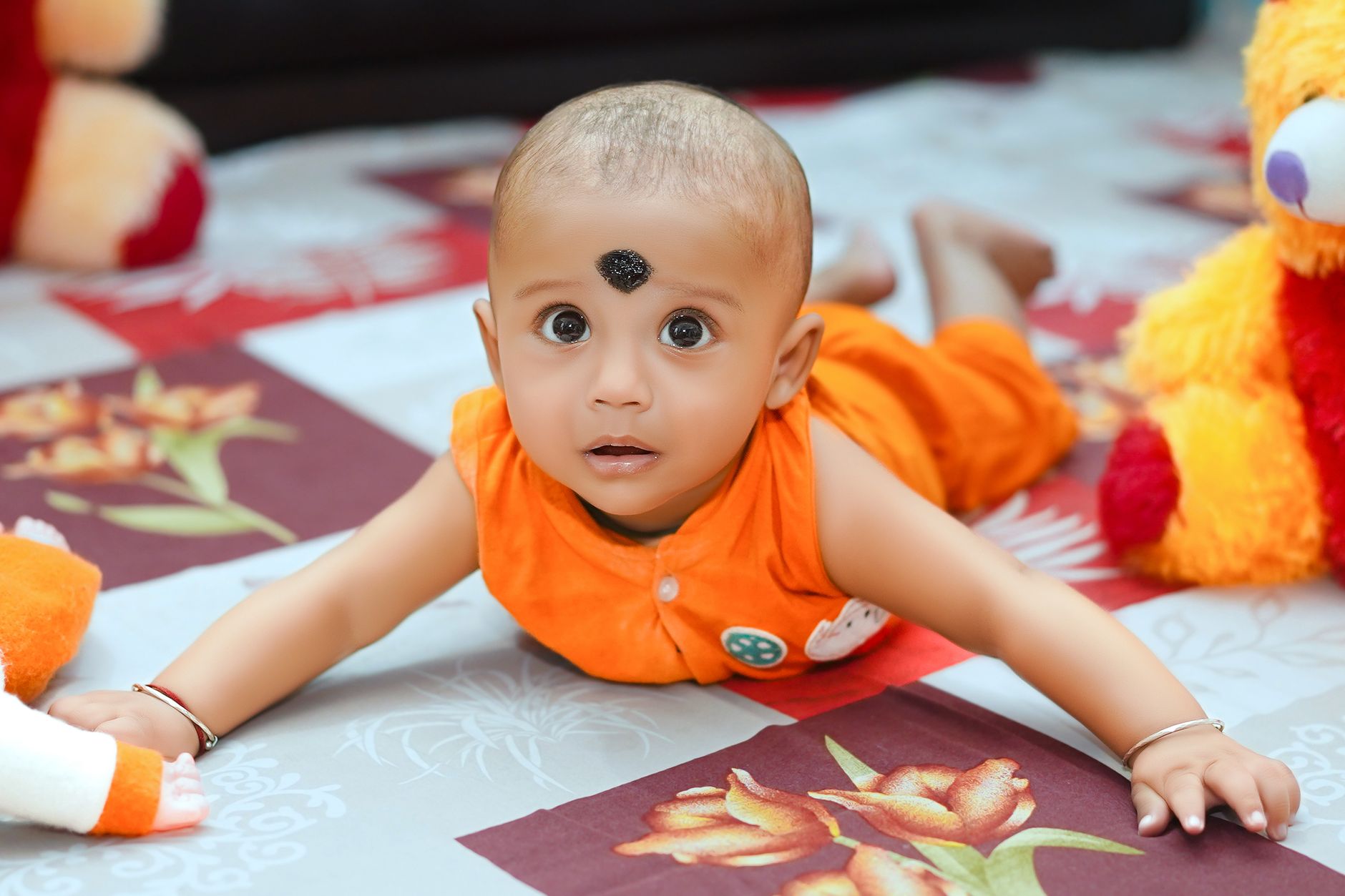
The mouthing is not the problem to solve. It is the activity. At five months, putting something in her mouth is how your baby finds out what it is — the AAP's milestone list for the end of this stage names "explores with hands and mouth" as a skill she is meant to be acquiring, not a behaviour to interrupt.
So the question is not how to stop her. It is what to hand her, where to put her down, and which handful of things to keep out of arm's reach.
Not medical advice — consult your pediatrician for anything specific to your baby.
Why the mouth, and why now
Her hands got useful before they got precise. By about the fourth month, says the AAP, most babies can easily bring an interesting object to their mouth — and the pincer grasp between index finger and thumb does not arrive until around nine months. In between, the mouth is the instrument with the most nerve endings and the best grip.
Researchers who study how babies investigate objects do not treat mouthing as a separate quirk. A 2024 review of infant object exploration in the journal Children lists mouthing alongside fingering, shaking, transferring and rotating as one of the behaviours that make up exploration itself. Taking the spoon out of her mouth is closer to taking a book off a reader than to breaking a habit.
Which is why the clinical advice is permissive, with one condition attached. The AAP says plainly: let your infant explore clean, safe objects with their mouth. Clean and safe are doing all the work in that sentence, and the second half of this article is about those two words.
From Indian paediatricians, the matching reassurance: the IAP's parenting guide notes that babies suck their fingers and thumb for comfort, that it is not a cause for concern, and that you should not try to stop it at an early age. Useful to have in writing when the comments start.
She is not bored. She is finished with that toy
The AAP's description of this stage says she will quickly get bored with even the most engaging toy, but will never tire of your attention. A two-minute attention span on a rattle is not a sign you bought the wrong rattle, or that she needs more of them.
The IAP's guidance for this exact window is mostly about you, not about toys: communicate with her, imitate her sounds, praise her when she imitates yours, put interesting things on the floor for her to reach out and explore, and take her outdoors to see the world. Three of those four cost nothing.
What she can actually do, four to six months
This band sits between the stages everyone writes about — past the newborn phase of an awake newborn, not yet at crawling, clapping and waving. Build play around what is emerging now: better hand control arrives around the fourth month, and passing an object hand to hand somewhere in the sixth to eighth.
| Emerging skill | What to offer |
|---|---|
| Rolling in both directions | Floor space on a mat, nothing to roll into |
| Sitting with support, then without | Your lap, your crossed legs, a propped corner |
| Reaching and grasping a large object | One light, large, unbreakable thing at a time |
| Passing an object hand to hand | Something easy to grip on two sides |
| Enjoying mirrors and faces | An unbreakable mirror, or your face |
| Babbling and copying sounds | Your voice, back and forth, in your own language |
The IAP expects a three-to-six-month-old to hold her head steady, turn over, sit with support, reach out and grasp a large object, enjoy mirrors, laugh aloud and make sounds. The AAP's list for the end of this stage adds rolling both ways, sitting first with and then without the support of her hands, and transferring an object from hand to hand. Ranges, not deadlines.
Where you put her down changes what she can do
This is the most useful under-known fact about this age. A 2014 study of twenty-nine 5- to 7-month-olds in the journal Infancy found they explored objects more with hands, mouth and eyes while supported in sitting than while lying on their back or front — and that while sitting they more often combined handling an object with mouthing and looking at it.
Practically: if she gives up on everything within ninety seconds on her back, prop her up. Sitting between your legs on the mat, or on a parent's lap facing the room, is a better setup for the exploring she is trying to do.
Tummy time still earns its slot. The NHS says it builds strength in the back, neck and shoulders and gives her a different view of the world; if she dislikes it, prop her up slightly with a small rolled-up towel under her arms. The AAP adds that tummy time is for a baby who is awake and closely supervised, and suggests a toy just out of reach, or a ring of toys around her, so reaching in different directions builds the muscles she needs to roll and later crawl. WHO's figure for a baby who is not yet mobile is at least 30 minutes of tummy position spread across waking hours, within several bouts of interactive floor-based play a day — in pieces, not at a stretch.
Activities that work in an Indian flat, with what you own
The kitchen drawer. The AAP suggests that when a baby tires of her usual playthings, plastic or wooden spoons, unbreakable cups and jar or bowl lids and boxes are endlessly entertaining and inexpensive — provided everything is unbreakable, lightweight and large enough that she cannot possibly swallow it. A steel katori she can bang and mouth beats most of what is sold as a five-month toy.
Cause and effect, on repeat. At around four months babies begin refining their idea of cause and effect — she notices the rattle makes a noise when she waves it, and then keeps testing it. Anything that answers back reliably — a crinkly dupatta, a lid on a steel tumbler, an unbreakable mirror propped up during tummy time — is a game.
Talking, in your language. The NHS advises talking and singing face to face in exaggerated sing-song ups and downs, because it helps her follow the movements of your mouth and supports early speech, and suggests seeing whether she copies you sticking out your tongue or blinking. Hindi, Tamil, Marathi, Bangla — whichever you actually think in.
Out of the flat. The IAP's four-to-six-month advice includes taking her outdoors and introducing her to the outside world. Early morning or after sundown through the hot months; a balcony counts on a bad-air day.
Dad's shift matters here. Two adults who play differently give her twice the material, and handing over for a stretch resets everyone — the one thing she will not tire of is a parent's attention. If you are setting up a floor corner, our playmat guide covers the one purchase arguably worth making; for the stage after this, see indoor activities for an older baby.
The safety half, because the mouth is the context
Everything must be bigger than her mouth. The AAP's toy rule is to think large: every toy and every part of a toy should be larger than your child's mouth. For a sharper line, the US consumer product safety regulator counts anything that fits completely inside a cylinder 57.1 mm long and 31.7 mm wide as a small part, because that approximates the fully expanded throat of a child under three. Home version: if it disappears into an empty toilet-roll tube, it does not go on the mat.
Sweep the floor she plays on. The AAP explains that babies and toddlers are at the highest risk of choking precisely because they explore by putting things in their mouths, where objects can lodge in a small airway — and suggests checking under furniture and between sofa cushions for coins, small toy parts and batteries. With an older cousin or a school-going sibling in the house, that sweep is the highest-value two minutes of your day.
Button batteries and magnets are their own category. The NHS is blunt: keep small silver button batteries well away from small children because they can cause severe internal burns if swallowed, keep magnetic toys with small pieces away because swallowed magnets can stick together inside a child's intestines, and keep toys made for older children away from babies because they often contain small parts. The AAP flags the same two hazards — loose button or lithium coin batteries and high-powered magnets end up in mouths, noses and ears. Remotes, kitchen scales, LED tea lights and fridge magnets live above waist height from now on.
And the general version. The AAP's movement guidance for this stage ends with the instruction to remove from her environment any object she could choke on or injure herself with. Not supervise harder. Remove.
Hygiene, without the panic
Someone in your house will be more worried about dirt than about choking. The proportionate version: a toy only your baby mouths, at home, is a low-stakes object — wash it when it needs it, and buy toys you can actually wash.
The risk rises when toys are shared. The AAP's checklist for group care asks specifically whether toys that infants put in their mouths are sanitised before another child plays with them, and puts frequent handwashing — yours and hers — at the centre of stopping infections moving around. So the creche toy, the playgroup toy and anything off a park bench get washed. The spoon from your own drawer does not need sterilising each time.
Teething and screens, briefly
Some of the mouthing is gums. The NHS lists chewing on fingers, toys and whatever else she gets hold of as a sign of teething, and warns that a teething ring must never be tied around her neck. The detail is elsewhere: what actually soothes a teething baby and steam-sterilisable teethers.
On screens the guidance is unanimous. The AAP states that infants do not need screens or media at this age, and WHO says screen time is not recommended under one year, suggesting reading and storytelling with a caregiver for the quiet stretches instead.
Frequently asked questions
She mouths everything. Should I be stopping her? No. The AAP's position is to let her explore clean, safe objects with her mouth — the work is in curating what is within reach.
My mother-in-law says she will fall ill from putting toys in her mouth. A toy only your baby mouths, kept reasonably clean, is a small risk. Shared toys are the ones worth cleaning between children, and handwashing is what most reduces infections passing around. A narrower rule than "nothing in the mouth", and easier to keep.
How do I know if something is small enough to be a choking risk? Anything fitting completely inside a cylinder 57.1 mm long and 31.7 mm wide counts as a small part, because that approximates the throat of a child under three. Simpler: every toy and every part of it should be larger than your baby's mouth.
She loses interest in every toy I buy. What am I doing wrong? Nothing. She is expected to tire quickly of even the most engaging toy while never tiring of your attention — and household objects like wooden spoons, unbreakable cups and box lids often hold her longer than bought toys.
She hates tummy time. Can I skip it? Change it, rather than skip it. Prop her up a little with a small rolled-up towel under her arms, and get down to her level with a toy just out of reach so there is a reason to lift her head. WHO's target for a baby not yet mobile is about 30 minutes of tummy position spread across the day — many short bouts, not one long one.