The swaddle has to go, and it has to go now. The American Academy of Pediatrics advises stopping swaddling as soon as a baby shows any signs of trying to roll over, and some babies start working on rolling as early as two months of age. Your son is already rolling, so you are not early — you are exactly on time, and the timing was never yours to pick.
The Lullaby Trust explains the risk in a single sentence: once a baby shows signs of rolling, stop swaddling them with their arms wrapped inside the material, because they could roll onto their tummy and not be able to roll back again — they cannot use their arms. Arms pinned, face down, no way to push up or turn his head. The NIH Safe to Sleep campaign says the same thing: stop swaddling during sleep once a baby starts rolling over on their own, and always place him on his back, for naps and at night.
Not medical advice — talk to your paediatrician about your own baby.
This is not bad luck: the AAP notes most children roll from stomach to back first, and by the end of the four-to-seven-month stretch will probably roll both ways. One relief comes with it — once he rolls both ways comfortably, you no longer need to keep turning him onto his back.
About "the sleeping pod" — two products, two different answers
If you mean a baby nest, pod or sleep positioner, those are not a sleep space. The Lullaby Trust advises against pods and nests because they are soft with raised or cushioned sides, and babies should not have anything soft around them, particularly their heads. It does not recommend wedges or positioners either: the safest surface is a firm flat mattress in a clear cot.
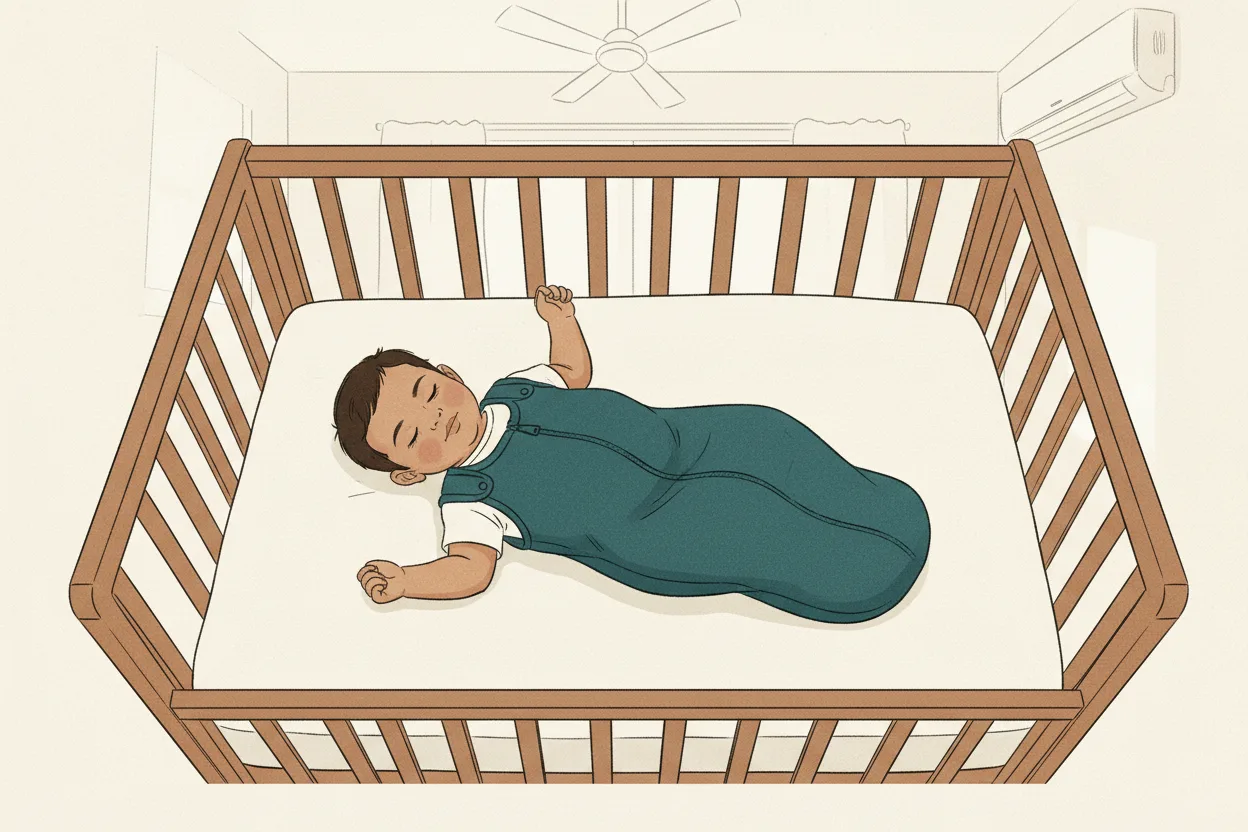
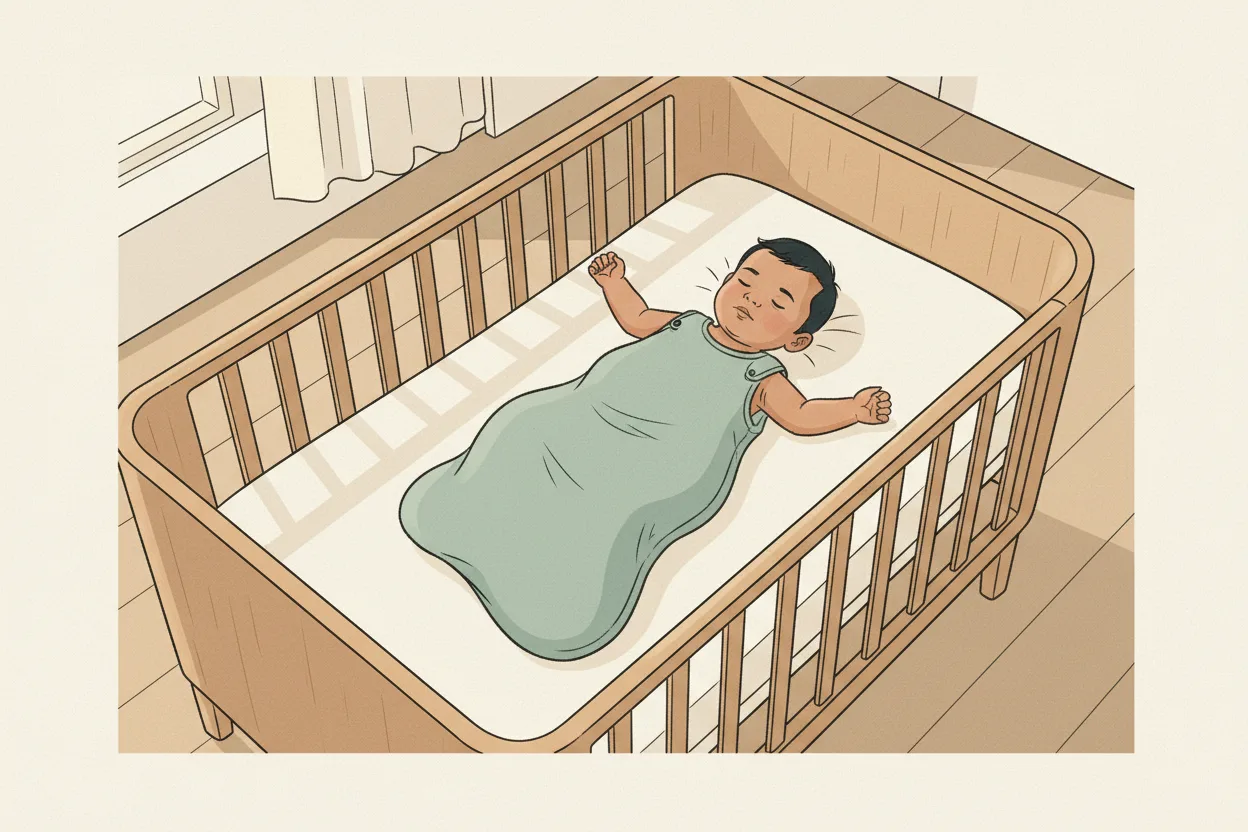
If you mean a wearable sleep sack or sleeping bag — a zipped garment with his arms out of the armholes — that is the safe option, and the thing frustrating you about it is the point. His hands coming free is not the product failing; it is a baby learning to sleep with his own arms. The NHS suggests a baby sleeping bag rather than swaddling precisely because the arms stay free. One fitting rule from The Lullaby Trust: it must fit well around the neck and shoulders so he cannot wriggle down inside, and most are sized by weight, not age.
Please put his hands down
You have been holding his hands all night and your own sleep is gone. That does not make you negligent; it makes you a parent improvising at two in the morning because the alternative was nobody sleeping.
But the real hazard is not the hand-holding itself — it is what an exhausted parent does next. The NHS is blunt: do not sleep on a sofa or in an armchair with your baby. The AAP puts the risk of sleep-related infant death up to sixty-seven times higher when a baby sleeps with someone on a couch, soft armchair or cushion. Sitting up all night holding an infant is how a parent ends up asleep in that chair without deciding to.
So keep his cot pulled right up against your bed. Room sharing without bed sharing is the safest arrangement and reduces the risk of SIDS — close enough to reach him, with your hands free. The wider setup is in our guide to baby sleep in the first three months.
What the startling actually is, and when it stops
It has a name. The AAP describes the Moro reflex: a baby whose head shifts abruptly, or is startled by something loud, extends his arms, legs and neck, then rapidly brings his arms together — and may cry loudly. That flinch is not a bad sleeper; it is a newborn reflex firing.
Here is the part that lifts some weight. The AAP notes the Moro reflex usually peaks during the first month and starts to disappear after about two months, and MedlinePlus puts the full fade at three or four months. Your son is past both. The reflex that started this is already on its way out.
What is left is mostly habit: he learned to fall asleep with his arms held still, and now expects it. Habits unlearn. You are managing a few weeks, not a permanent feature of your child — and none of this is sleep training.
Running the arms-out transition
The usual advice steps down one arm at a time over a couple of weeks. That is more time than you have. So split it: step down at daytime naps, where you can watch him, and go arms-free at night straight away.
- Today, at naps: swaddle with one arm out and stay in the room. This is the only stage with fabric still around an arm, so it happens in your sight — arms wrapped inside the material is precisely what stops once a baby shows signs of rolling.
- Tonight: sleeping bag, both arms free, on his back for every sleep, on a firm flat mattress in a clear cot.
- After two or three days: second arm out at naps too.
- End of the week: the swaddle is retired. Sleeping bag for every sleep, day and night.
Most families describe a few rough nights rather than a lost fortnight. Expect the first two to be the worst, and judge it on the fifth night, not the first.
Instead of holding his hands: rest one flat palm on his chest without pressing, shush low and steady, and lift your hand off before he is fully asleep — replacing restraint with contact, then removing the contact. A firm flat mattress helps too: a surface that does not give lets him brace his own arms against something.
And pick your week. Start when your husband, your mother or your mother-in-law can take a shift, not on a week you are alone with him — it is much harder solo.
Dressing him for an Indian bedroom
Fabric weight matters more here than the guidance suggests. The NHS advises keeping the room between sixteen and twenty degrees Celsius and warns that overheating can increase the risk of SIDS — a range most Indian bedrooms sit well above for much of the year.
So buy the lowest tog sleeping bag you can find, in cotton or muslin, not the padded winter one marketed as "cosy". For a room warmer than twenty degrees, The Lullaby Trust says a lightweight layer is enough — a short-sleeve bodysuit, or even just a nappy — and never add blankets on top of a sleeping bag. Check his chest or the back of his neck, not his hands and feet, which run cool. In an air-conditioned room, step up a tog rather than adding a blanket.
Do not buy a weighted sleep sack
Parents searching this exact problem at two in the morning are marketed these hardest: the pitch is a hand on the chest without your hand.
Skip them. The AAP says not to use weighted blankets, sleepers, swaddles or other weighted objects on or near your baby. The US Consumer Product Safety Commission, quoting the CDC, states that weighted products such as weighted sleepers, weighted swaddles, weighted sleep sacks and weighted blankets are not safe for infants, and the AAP cites evidence that weighted sleep products can lower infants' oxygen levels. The Lullaby Trust does not recommend them under one year either, citing overheating, head covering and pressure on a baby's chest.
A plain, unweighted, low-tog sleeping bag is the answer.
Where to read next
We also cover timelines for sleeping through the night and moving him into the cot without waking him.
You are doing the right thing at the right time, on no sleep. Get his hands free, get your own hands back, and give it five nights.