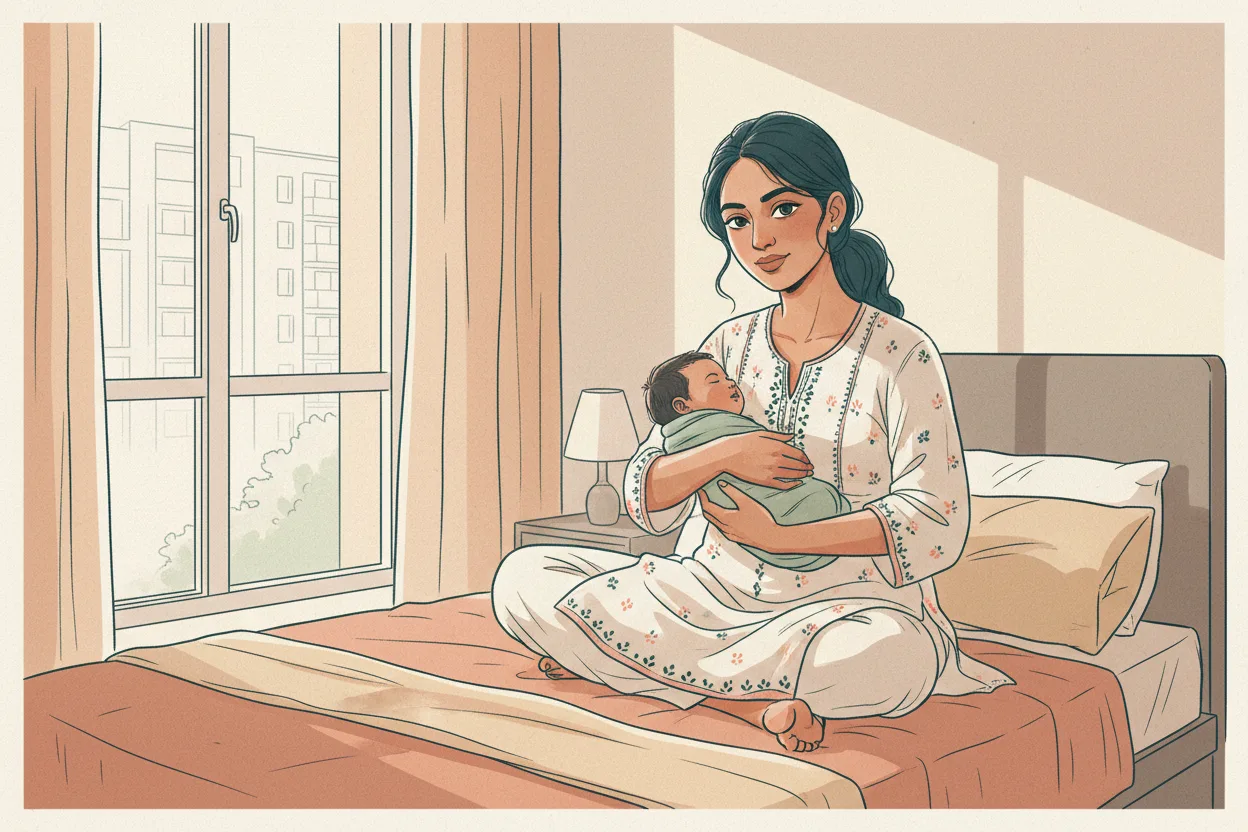
At five weeks, a baby who naps only on a parent is behaving exactly as a five-week-old behaves. The AAP notes that although newborns sleep about 16 to 17 hours a day, they may only sleep one or two hours at a time — and that babies do not have regular sleep cycles until about four months of age. You have not created a habit. You have a newborn.
The thing worth changing is not the contact napping. It is where you are if you might fall asleep during one. The AAP warns that the risk of sleep-related infant death is up to 67 times higher when infants sleep with someone on a couch, soft armchair or cushion. If you read nothing else here, read the section on the sofa.
Not medical advice — discuss your baby's sleep with your paediatrician.
Why Five Weeks Looks Like This
Newborn sleep is not one long block that a good parent unlocks. The NHS says some newborns sleep a total of around eight hours a day and others up to around 18, either is perfectly normal, a baby may sleep in short or long bursts, and it is highly unlikely they will sleep through the night because their tummies are tiny and they need to be fed.
So the fact that he used to take one or two naps on the bed and now takes none there is not a regression you caused. Nor are you spoiling him by holding him. The AAP states that you cannot spoil a young baby with attention, and that if you answer their calls for help they will cry less overall. The IAP's own parent guideline lists holding a baby in arms until they fall asleep as a perfectly acceptable way to settle a baby from birth to six months, with a soothing voice or gentle stroking when you put them down.
That matters here, because in most Indian homes the pressure runs both ways at once. A mother-in-law raising babies in arms and a cousin quoting a sleep-training reel can both be in the same room by Sunday lunch. At this age there is simply nothing to train.
The One Version of Contact Napping That Is Genuinely Dangerous
A contact nap is fine. A parent falling asleep during one, on a sofa or an armchair, is not. This is the part almost nobody is warned about, and it is exactly where an exhausted mother ends up at 3 pm with a baby on her chest and the TV on. Five weeks is also the window where it matters most: the NICHD states that 90 per cent of SIDS deaths occur before six months of age, and that the number of deaths peaks between one and four months.
The NICHD's Safe to Sleep campaign puts it plainly: couches and armchairs are particularly dangerous when an adult falls asleep on them while feeding or comforting baby. NHS safer-sleep guidance says do not sleep on a sofa or in an armchair with your baby. The Lullaby Trust's advice is the practical version: if you think you might fall asleep on a sofa or armchair, put the baby down in a safer place to sleep first.
Notice the shape of that advice. The problem is the surface and your own sleep, not the holding. So:
- Take the long, likely-to-knock-you-out contact naps on your bed, prepared as below — the Lullaby Trust tells parents who may fall asleep to prepare the bed instead.
- Keep the sofa and the recliner for the naps you are awake for, and move the moment you feel yourself going.
- If your mother or mother-in-law is staying, the most useful thing she can do is sit with the baby on her while you lie down — not hold him while you both doze off in the drawing room.
Your Bed, Handled Honestly
You already co-sleep, so the useful thing is not a lecture. It is knowing which parts of your setup guidance actually flags.
The NICHD recommends room sharing — the baby's own sleep space near but not in your bed — as safer than sharing your bed, and notes it makes it easy to check on, feed and comfort the baby without getting all the way out of bed. Our guide to bedside cots, bed-sharing and baby nests compares those options for an Indian bedroom.
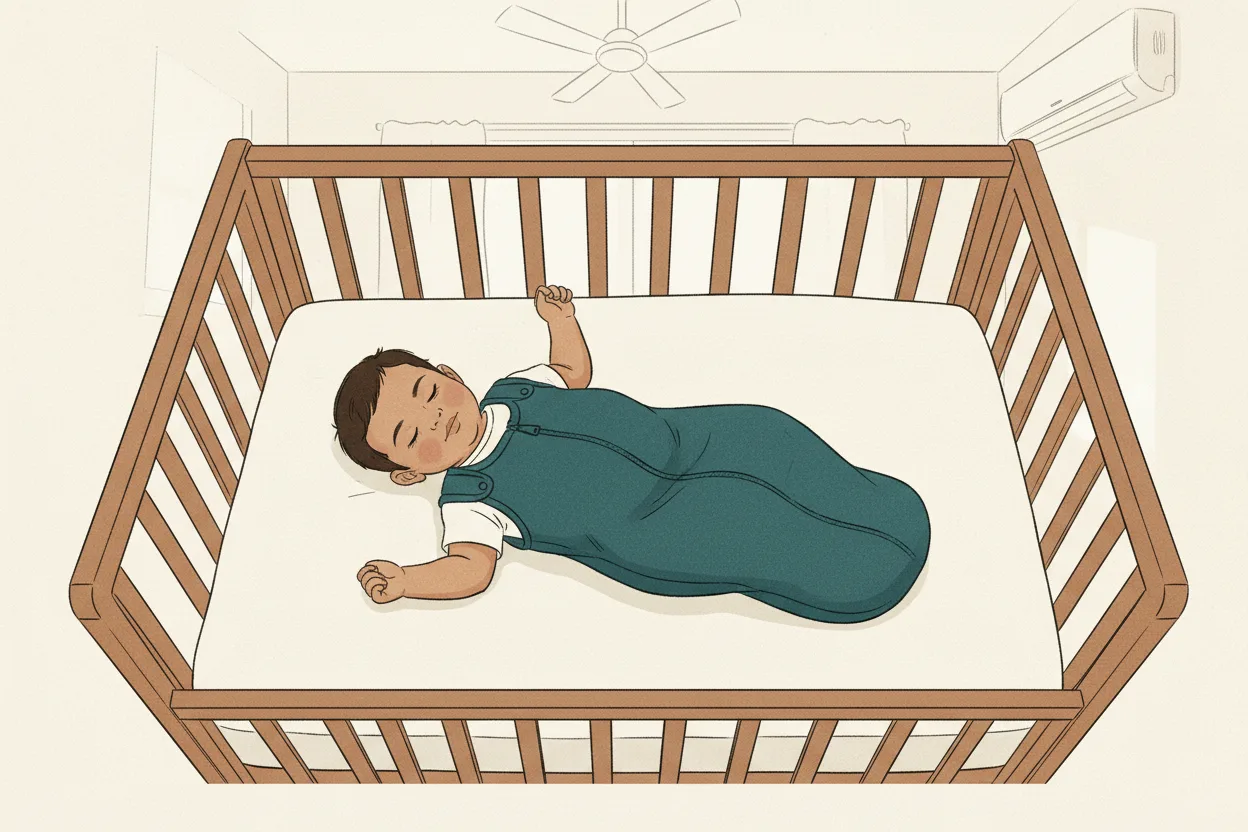
Guidance also names circumstances in which bed-sharing becomes clearly more dangerous. NHS guidance says not to share a bed if the baby was born premature, before 37 weeks, or had a low birthweight under 2.5 kg; if anyone in the bed smokes, has had two or more units of alcohol, or has taken drugs; and it asks that the baby sleeps on a firm, flat mattress on their back with pillows, sheets and blankets kept away.
| What guidance flags | Why it matters |
|---|---|
| Sofa or armchair | The highest-risk surface of all, awake or asleep |
| Smoking, alcohol, sedating medication | Named reasons not to bed-share at all |
| Born before 37 weeks, or low birthweight | Named reasons not to bed-share at all |
| Pillows, duvets, quilts, cot bumpers near baby | Soft bedding is the thing to clear, not the bed itself |
| Soft or sagging mattress, gaps at the headboard | A firm, flat surface is the requirement |
The honest summary: nobody can tell you bed-sharing is risk-free, and we are not going to. But if you might fall asleep during a night feed lying down, a bed cleared of hazards is the surface guidance points you to, and the sofa is the one it tells you to get off. Decide the rest with your paediatrician. For the bedding and warmth question — how many layers, what comes out of the cot — see what actually goes in the bassinet.
How to Actually Get Rest
Half-nights with no daytime rest is the real problem in your question, and it is solvable without changing the baby at all.
Run shifts with your partner. The AAP advises parents to take shifts with nappy changes and with rocking and calming the newborn, because even just a few extra hours in bed helps parents cope better with the stresses of new parenthood. Concretely: he takes the settling and the pacing from 9 pm to 1 am and wakes you only to feed, so you get one real block instead of six broken hours.
Sleep while he contact-naps on the other parent. This is the only version of "sleep when the baby sleeps" that still works once naps have moved onto a body. The NHS's coping advice is to sleep or rest whenever your baby sleeps, accept or ask for help from friends and family, and ignore non-essential jobs around the house. The dusting is not the priority this month.
Wear him for daytime naps so you can move. The AAP suggests walking a baby in a body carrier or rocking them, because calming motions remind babies of the movements they felt in the womb. A soft carrier turns a contact nap into a nap you can stand up during — but a newborn in a sling needs checking, not forgetting:
- The AAP's carrier guidance is that in a sling your baby's neck should be straight and their chin not pressed into their chest, you should always be able to see their face, and their mouth and nose must not be blocked by fabric or your body.
- The Lullaby Trust's TICKS checklist is the version to memorise: tight, in view at all times, close enough to kiss, keep chin off the chest, supported back.
- In practice that means high and tight enough to kiss the top of his head, with his face turned out and clear of fabric — and the chin off the chest.
If the transfer is what keeps failing, the technique is written up in the dreaded transfer. And if what you feel is less "tired" and more "cannot bear to be touched again", see touched-out and exhausted and our survival guide for newborn sleep deprivation.
So Would a Jhula or Cradle Fix It?
Probably not for the reason you are hoping, and it changes the safety picture. AAP safe sleep recommendations state that sitting devices such as car seats, strollers, swings, infant carriers and infant slings are not recommended for routine sleep at home, particularly for babies under four months, and that a baby should sleep on a firm, flat non-inclined surface.
A jhula or thooli may buy you twenty minutes of motion while you eat. It is a settling tool, not a sleep surface — and the dependency question is argued out in when do babies outgrow the jhula and thooli to crib. The inclined-seat version of the same problem is in baby bouncers and rockers.
What Not to Do at Five Weeks
Do not sleep train him. There is no behaviour here to correct: the IAP guideline for babies from birth to six months is simply that the baby can be held in arms until they fall asleep, and the AAP's position is that you cannot spoil a young baby with attention. Fix your sleep, not his.
Change exactly one thing this week: get off the sofa for the naps you might fall asleep during. Everything else can wait for your baby to grow, which is the only thing that actually resolves this.